Printable 1 of 6
A flash among the willows
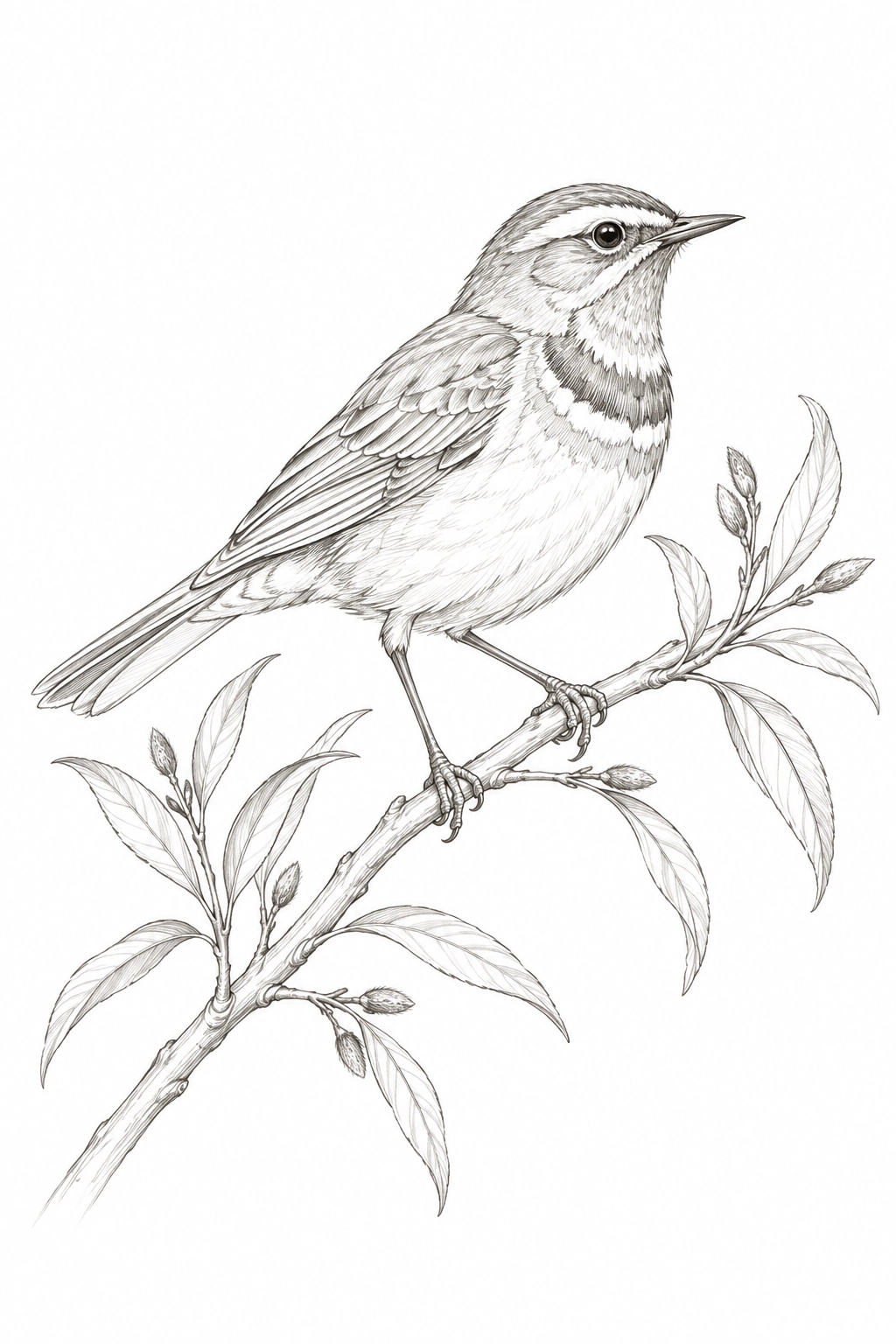
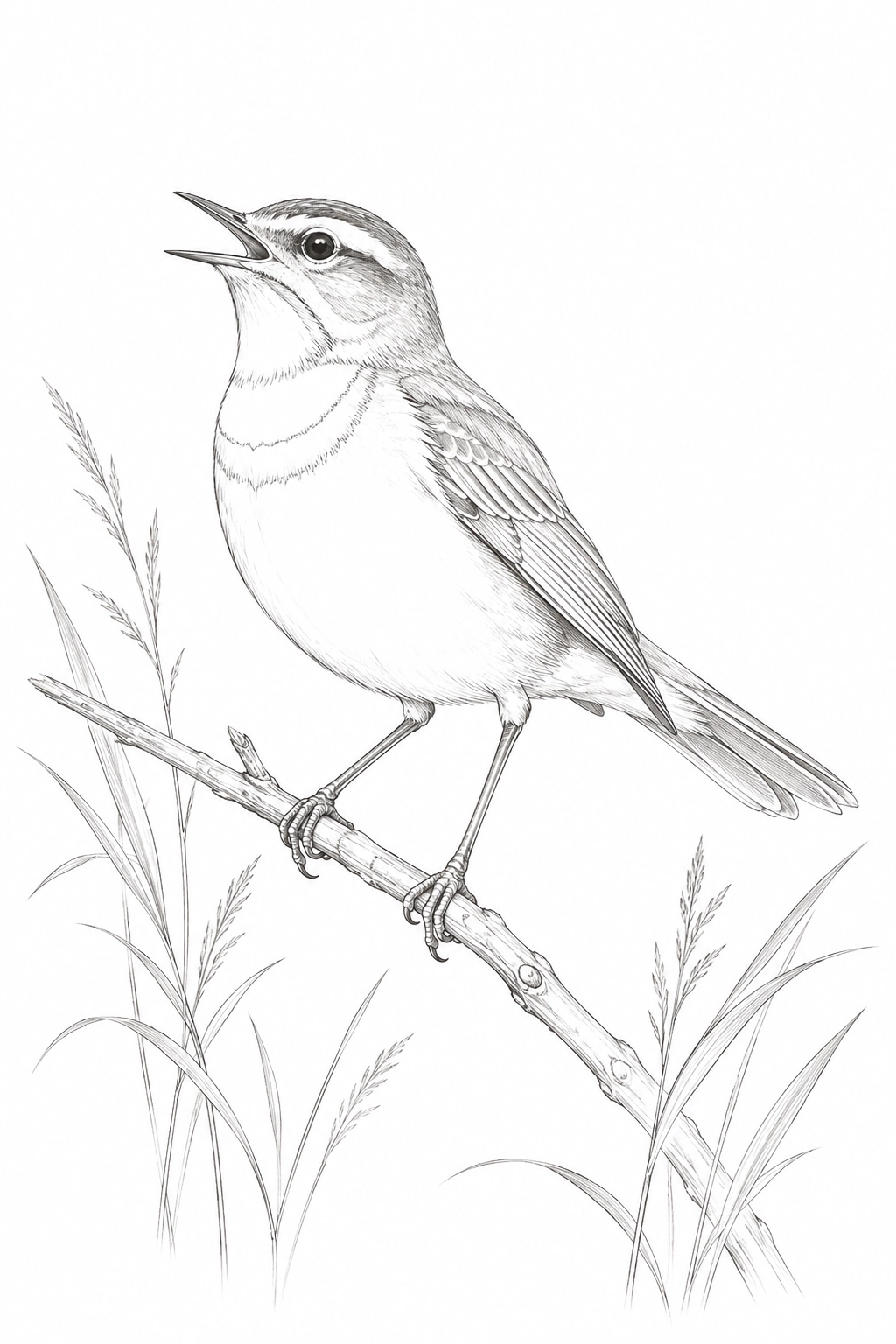
A poised bird among willow leaves, with wing structure to guide a loose watercolor study.
 Fontes Living LibraryNatural history · Field notebook No. 02
Resource curated by Jane Forster
A living study of the Bluethroat: a flash of blue in the undergrowth, a singer full of surprises, and a traveler whose journey is still being pieced together.
Step into the thicket ↓Luscinia svecica · Advanced middle school through adult
With quieter doorways for younger naturalists.
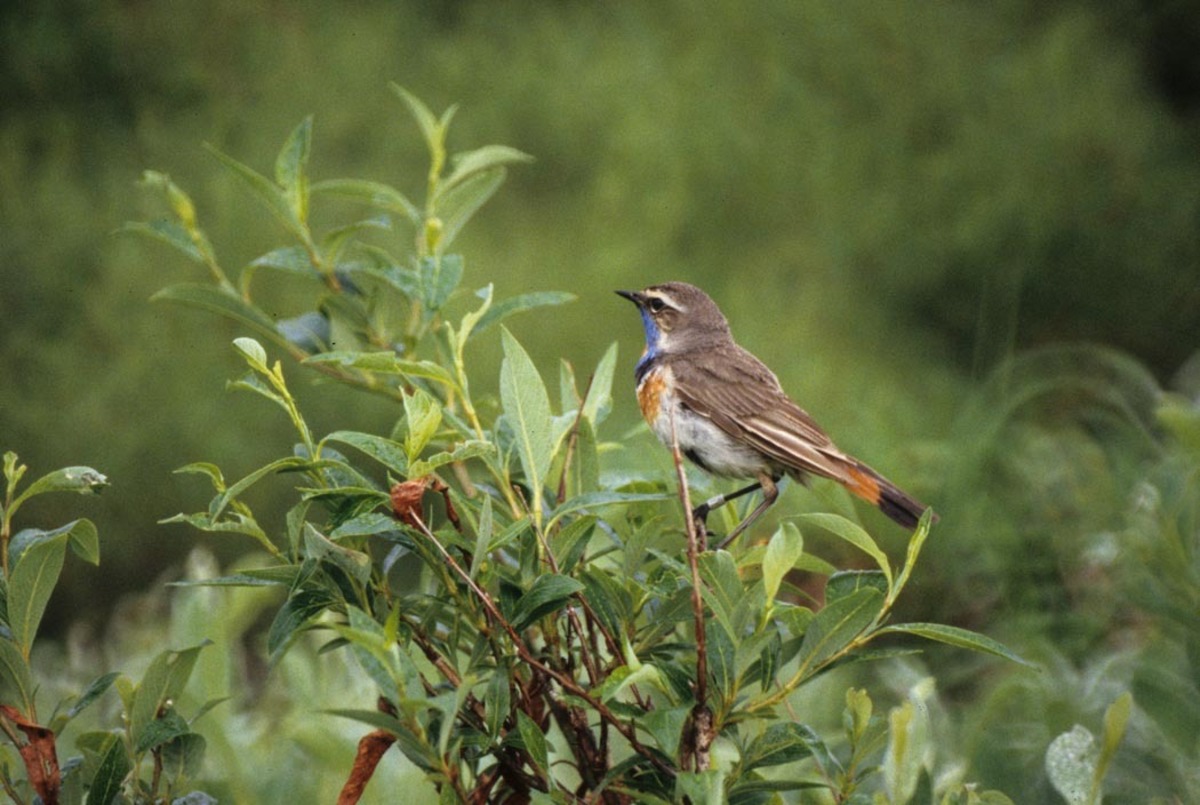
Imagine standing beside a northern stream while the low willows stir. This opening is an imagined encounter, not a report of a particular bird. Something moves where the branches meet the earth. Brown feathers, a pale eyebrow, a tail that seems to contain a spark. Then the bird turns.
For a moment, there is blue where you expected shadow.
It would be easy to make that moment the whole story. A beautiful bird; a beautiful photograph. But stay a little longer. Beauty can be the door through which a difficult question enters. Why display a brilliant throat when the rest of the body disappears into brush? How can one singer seem to borrow the voices of others? And where does this small life go when the northern summer ends?
A name can help you find a bird. It can also make you overlook one.
The bird in this study is the Bluethroat, Luscinia svecica. You may encounter the genus name Cyanecula in research papers, and “thrush” in older descriptions. Modern sources such as the British Trust for Ornithology place it in Muscicapidae, the Old World flycatcher family. Names change as scientists reconsider relationships; the living bird does not wait for our labels to settle.[4]
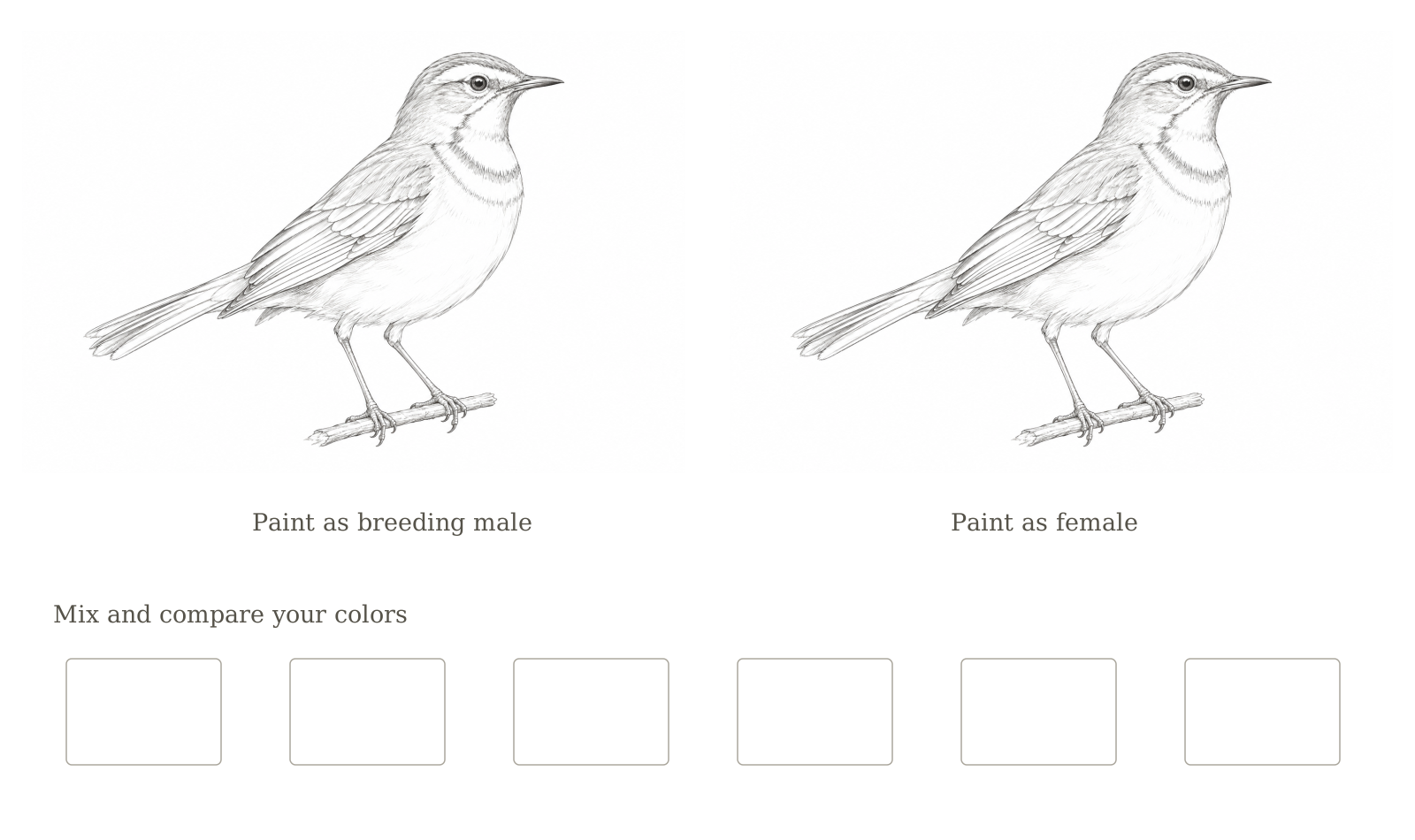
Look at a breeding male from the front. The throat can be intensely blue, with darker and rusty bands below. A central patch may be red, white, or absent, depending on the form. Now turn your attention to less spectacular clues: the pale stripe above the eye, brown upperparts, and rusty patches at the base of the tail. Females and young birds can look much plainer. A name that promises blue is not a guarantee that every bird will show it.[1]
Learning to recognize a bird is therefore more like learning a face than memorizing a colored badge. You notice proportion, movement, setting, and several markings together. Close the page for a moment and describe this bird aloud without using the word blue. What remains?
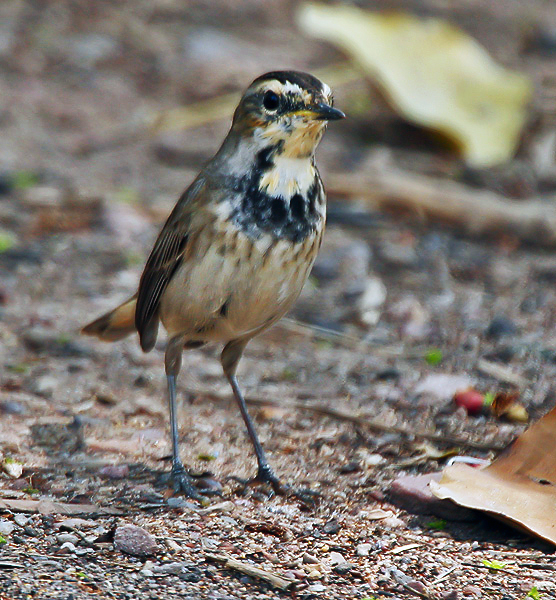
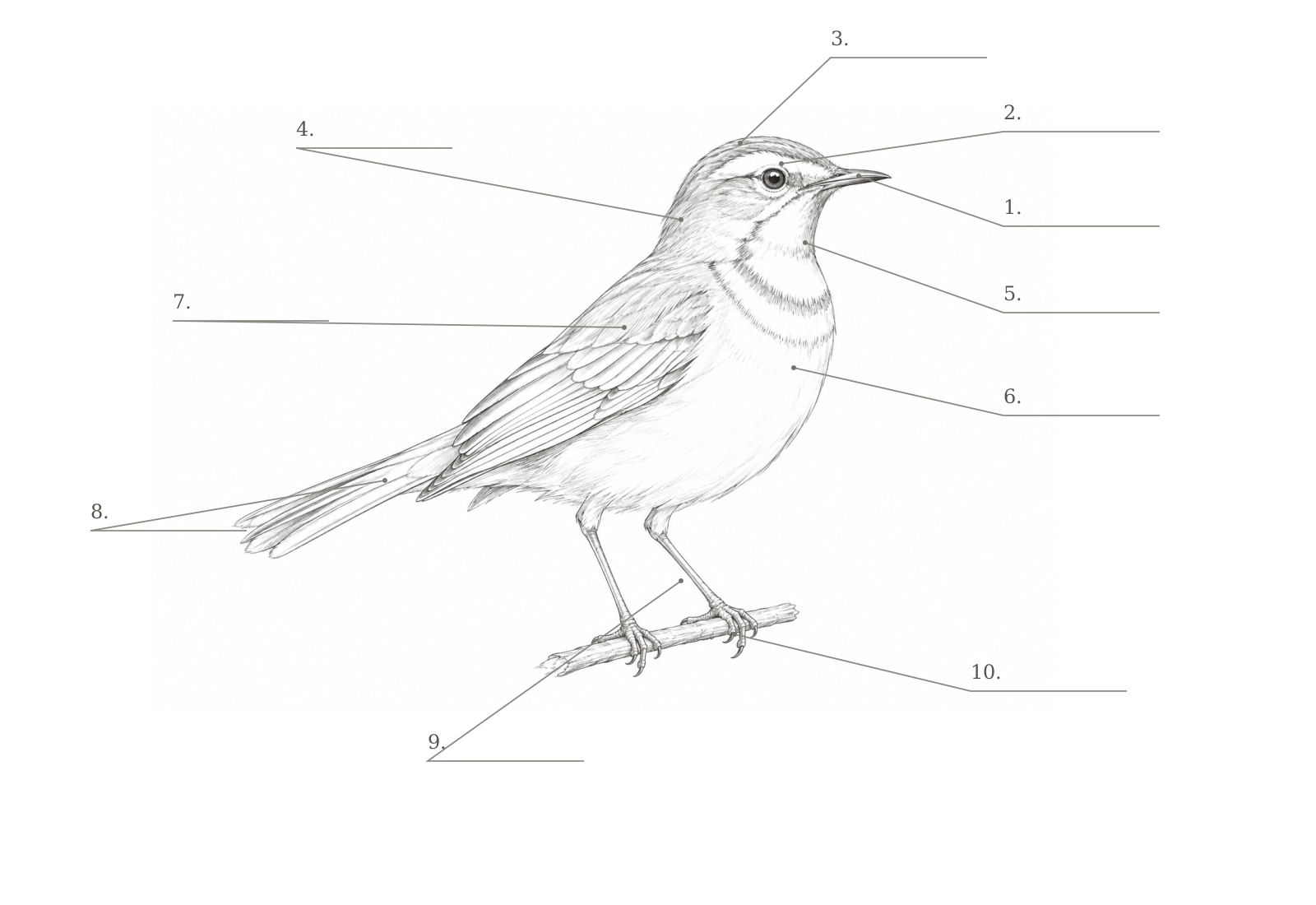
Choose a view. This original diagram is a simplified teaching illustration, not a specimen, identification plate, or exact portrait.
Patterns summarized from Cornell identification and the CSIC species account. [1] [5]
The photograph is not the end of the color story. Male throat feathers reflect ultraviolet light. In a 1997 experiment, researchers altered that reflection without creating a difference visible to human observers. Females associated more with the comparison male in 13 of 16 trials. That finding supports a role for ultraviolet vision in mate choice.[6]
A later field experiment also investigated how reduced ultraviolet ornamentation affected pairing and reproductive outcomes.[7] The important idea is wonderfully unsettling: our eyes are not the measure of everything there is to see. A bright patch can carry information unavailable to us.
Look at one photograph for a quiet minute. Close it. On paper, draw the bird’s outline and three markings you remember. Reopen the photograph and notice one thing you missed. Younger learners can tell an adult their three discoveries instead. No drawing needs to be uploaded.
Comstock’s Bluebird companion asks children to notice the bluebird’s head, back, breast, wings, and tail while a living Eastern Bluebird is in view. Compare those colors with the Bluethroat photographs here. Where does each bird carry blue? What might the name cause you to overlook? These are separate species with different lives. Make a two-bird color sketch in your paper nature journal, then open the field questions if a bluebird is nearby.
A bird’s home is not simply a point on a map.
Bluethroats breed across a broad sweep of Europe and Asia, reaching western Alaska. Their nonbreeding grounds include parts of southern Europe, Africa, and southern Asia. Different populations make different journeys; neither the breeding range nor the winter range is occupied uniformly.[10]
In Alaska, a promising home includes low willow or birch thickets near water, with tundra around them. Elsewhere the settings differ: Eurasian birds use several kinds of low, brushy habitat.[3] The Spanish species account describes mountain shrublands as breeding habitat and reedbeds and wetlands during migration.[5] “Wetland bird” is useful shorthand, but it is not a complete address.
Try shrinking your imagined world to a bird’s height. A bank that looks empty from a path becomes a tangle of stems, soil, hiding places, and feeding surfaces. Shelter is something a bird can move through, not merely something it stands beside. A photograph records where the bird was visible. It may tell you little about where the bird spent the previous hour.
From a safe path, sit or crouch beside a garden or park shrub. Without entering the vegetation, look for three things a small bird might use: cover, a feeding surface, and a place to perch. Sketch a little map in your nature journal. You do not need a Bluethroat nearby to practice seeing habitat.
For most readers in Texas or elsewhere far outside its usual range, this is a study of a bird you are unlikely to find in your neighborhood. That need not make it distant. Compare its habits with a local bird and let the unfamiliar creature teach you to notice the familiar one.
Before naming a sound, learn to hear its shape.
The Bluethroat’s song is varied and can include imitations of other birds. A male may sing from a conspicuous perch or during a short song flight. The same bird that vanishes into low brush can become briefly difficult to ignore.[3]
Listen for changes rather than counting notes. Are the phrases smooth or broken? Repeated or restless? Does a whistle give way to a rattle? You are not required to hear every detail at once. A first listening gives you the outline; a second may show you the hinges.
Song and call are not interchangeable labels. This exercise uses field recordings of birdsong. It is a listening comparison, not a promise that you can identify every Bluethroat from one clip. Mimicry, individual variation, and other birds in the background make real listening more complicated.
One is a Bluethroat; the other is an American Robin. Listen to both before making your guess. You may replay them as often as you like.
Real outdoor sound; multiple phrases and background noise. Identity appears in the answer and credits below.
A brief real field recording. Listen for the sequence of changing sounds rather than one isolated note.
B is Justin J. F. Jansen’s Bluethroat recording, made at Kraaijenbergse Plassen, Netherlands, 8 April 2016. Source · CC BY 3.0. A is G. McGrane’s American Robins in North Carolina, 2007, public domain. Full recordings are retained; MP3 versions are format conversions. Neither has spoken words. If hearing the audio is difficult, use the written descriptions, photographs, and visual questions; sound identification is optional.
Watch the tail, posture, and pauses. What can you observe directly? A small Bluethroat stands and moves in an outdoor setting; there is no spoken narration. Aviceda, Riyadh, September 1993 · CC BY-SA 3.0. Complete 18-second clip, converted to MP4; conversion under the same license.
Look for bill movements and the direction the bird faces. There is no spoken narration. The first 75 seconds of Marc Plomp / Natuur Digitaal / Stichting Natuurbeelden’s film, Texel, 14 April 2011. CC BY-SA 3.0 NL. Trimmed, resized, and converted; this excerpt uses the same license. The source has the full film.
Take paper outdoors. For two minutes, listen without hunting for the singer. Make dots for short sounds, lines for long sounds, and rising marks for phrases that seem to climb. These are your own listening marks, not a scientific spectrogram. Tell someone how the sounds changed. Listen quietly; do not play recordings to attract wild birds.
The Mockingbird companion brings Comstock’s questions to a living Northern Mockingbird. Listen for a repeated phrase, a sudden change, and the bird’s posture; then listen again to the Bluethroat recording above. Which details did you actually hear, and which are your guesses about imitation? The mockingbird and Bluethroat are different species, and one singer’s habit does not explain the other. If a mockingbird visits your neighborhood, take the observation questions outdoors.
The loud singer and the hidden nest belong to the same life.
Breeding is a sequence, not a single event: territory and courtship, pairing, nest building, egg laying, incubation, and the demanding work of feeding young. Displays and song are only the part most easily noticed. The female makes a woven cup, placed on the ground or low in dense vegetation. Grasses, sedges, fine twigs, and rootlets can become the structure; softer material lines it.[2]
There is no one breeding date for a species spread across so many climates. A study of a population in western France describes egg laying between April and July.[11] Northern schedules must be understood in their own local conditions. Treat the calendar below as a broad seasonal story, not a timetable for every bird.
A typical clutch is often described as five to seven eggs. The female incubates; the hatchlings are altricial, dependent young rather than miniature adults ready to fend for themselves.[4] Cornell describes eyes closed at hatching and gray down.[2] Both parents bring food. Incubation and the nestling period are each roughly two weeks, with differences among references and populations.[3][4]
A broad Northern Hemisphere cycle. Exact timing, routes, and number of broods differ by population. [3] [4] [10] [11]
A species account summarizes observations. It may cover one region or rely on different studies from another account. Small differences such as 13–14 versus 14–15 days should lead us to ask what was measured and where. “About two weeks” is useful for understanding the life cycle; it is not permission to predict a particular hatch date.
Use paper strips, dry grass already lying on the ground, or short pieces of raffia. Try making a shallow cup that holds five small paper “eggs.” Add a lining and compare how it behaves. This is a model of a construction problem, not a replica nest. Leave real nests and nest materials in place; keep string, glue, and craft scraps indoors.
A food web is a set of relationships, not a ladder with a winner at the top.
For the Bluethroat, a patch of ground can be a hunting place. Insects and other small invertebrates are important food; in autumn, small fruits and seeds also enter the diet.[5] Cornell describes picking prey from low vegetation and the ground, turning leaves and soil, and sometimes catching flying insects.[2] Notice the distinction between what it eats and how it searches. A food list alone cannot show the whole task.
But a bird finding food is itself part of another animal’s search. The Spanish vertebrate encyclopedia reports Bluethroat among the prey of the Booted Eagle in a study in Ávila.[12] That is a documented relationship in a particular place. It is not a complete list of predators throughout the bird’s enormous range.
Eggs, helpless nestlings, fledglings, and adults face different dangers. A study of breeding success in western France identifies nest predation as an important source of failure.[11] The evidence supports that statement. It does not justify inventing a universal cast of foxes, snakes, hawks, and cats and presenting every one as a verified Bluethroat predator.
This is a useful discipline for a naturalist: know the difference between something possible and something observed. “A predator could enter the thicket” is an inference. “A Bluethroat was found among this eagle’s prey” is evidence of a specific interaction.
Draw cards for a plant, an insect, the Bluethroat, and a Booted Eagle. Connect only relationships supported in this study. An arrow runs from food to consumer. Which insect’s food remains unknown? Leave that connection uncertain rather than making it up. Older learners can research a named insect; younger ones can explain why the blank space is honest.
To discover where a bird goes, researchers sometimes begin with sunrise.
A light-level geolocator records changing light. Researchers use the timing of dawn and dusk to estimate position. It is not a tiny GPS track with every turn precisely marked. Shade, latitude, season, and the need to recover the logger all complicate the story.
In a 2015 study, four recovered tracks from male Red-spotted Bluethroats breeding in Norway and the Czech Republic led to wintering places in India and Pakistan. The winter areas lay, on average, more than 6,000 kilometers from the breeding areas.[8] Put that distance beside the bird’s photograph. The scale changes what you see.
In a 2022 study, researchers attached loggers to 30 males in northeastern Siberia but recovered one. Its data suggested a wintering area in Myanmar and a route east of the Himalaya. Much of the light data was poor; the authors treated the route as an inference.[9] One recovered bird is an astonishing clue, but not a census of the whole population.
A 2025 paper added a central Siberian bird whose wintering area was estimated near the border of northwestern India and Pakistan. The authors reported possible stopovers and warned about uncertainty in timing and locations.[10] Science did not erase the mystery. It made the next questions more exact.
Teaching diagram with approximate regional positions. Connections are schematic, not range boundaries, exact flight paths, or locations of individual nests. See the linked papers for their maps and uncertainty estimates.
Find Norway, the Czech Republic, Siberia, India, Pakistan, and Myanmar in an atlas. Lay thread between a breeding region and a winter region. Then locate major mountains and dry regions along the way. The thread connects places; it does not prove a bird flew straight between them. Tell someone why a stopover may matter as much as a destination.
When you next hear a small bird in a bush, its present location will be only one page of its life. You may not know the other pages. The Bluethroat reminds us that ignorance can be a beginning: a reason to look carefully, keep records, and ask a question worth following.
Read. Close the page. Meet the world.
Open a small collection designed for older students and adults: three airy watercolor compositions, an external-anatomy labeling plate, a male–female plumage comparison, and a field observation page. Natural poses and selected feather contours guide the eye while leaving room for your own color and brushwork.
Original teaching illustrations. Use real bird photographs as reference; botanical arrangements are artistic compositions. View each complete drawing below.
A poised bird among willow leaves, with wing structure to guide a loose watercolor study.
Paint a male and a female using real photo references; bring your own brushwork to the botanical arrangement.
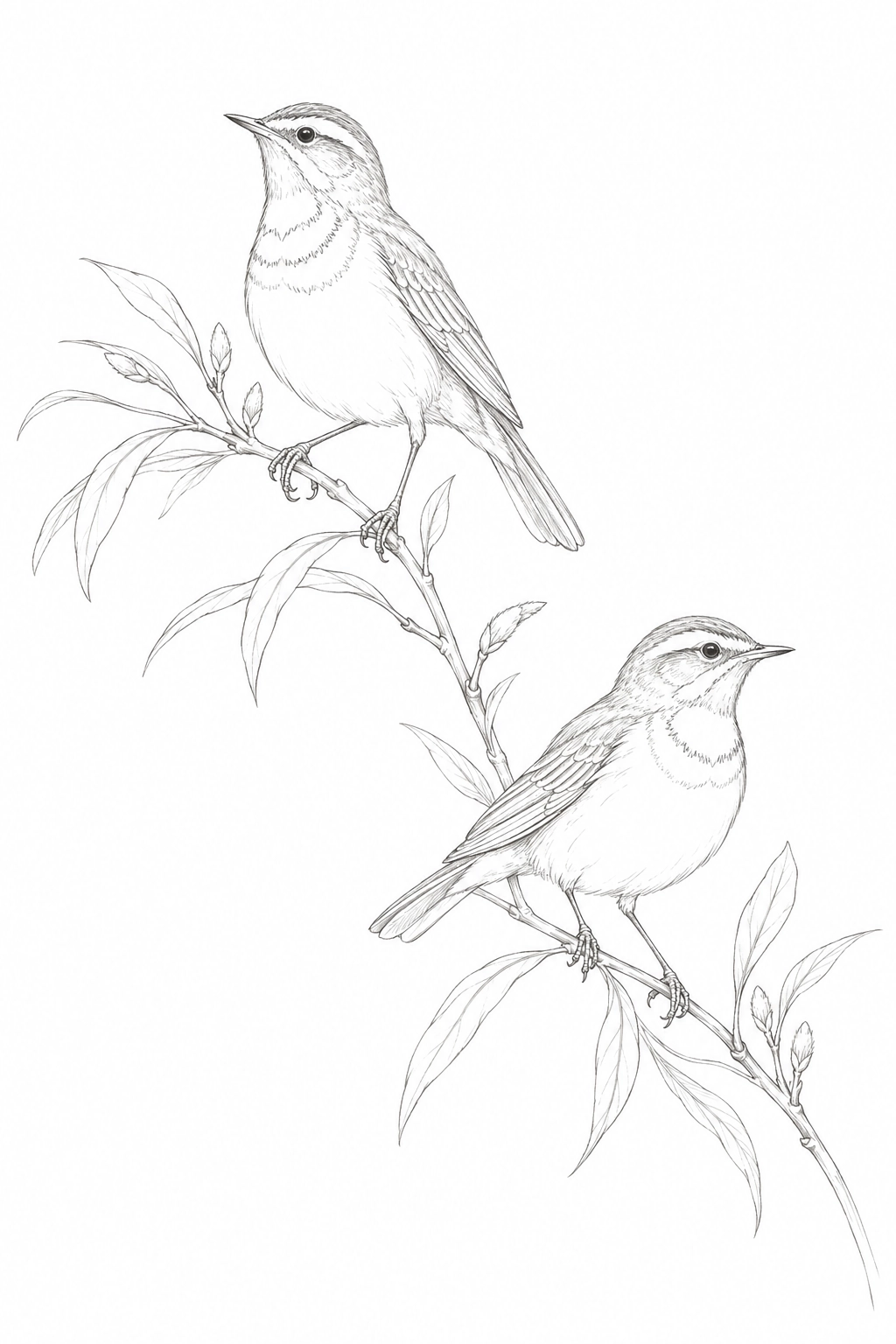
Explore stems, negative space, and a small bird within a larger setting.
Ten external regions to label on paper. The printable’s screen view includes a separate answer key.
Compare a breeding male and a plainer female. The printable also includes blank color-mixing swatches.
Use paper spaces to separate habitat sketches, observations, and possible explanations.
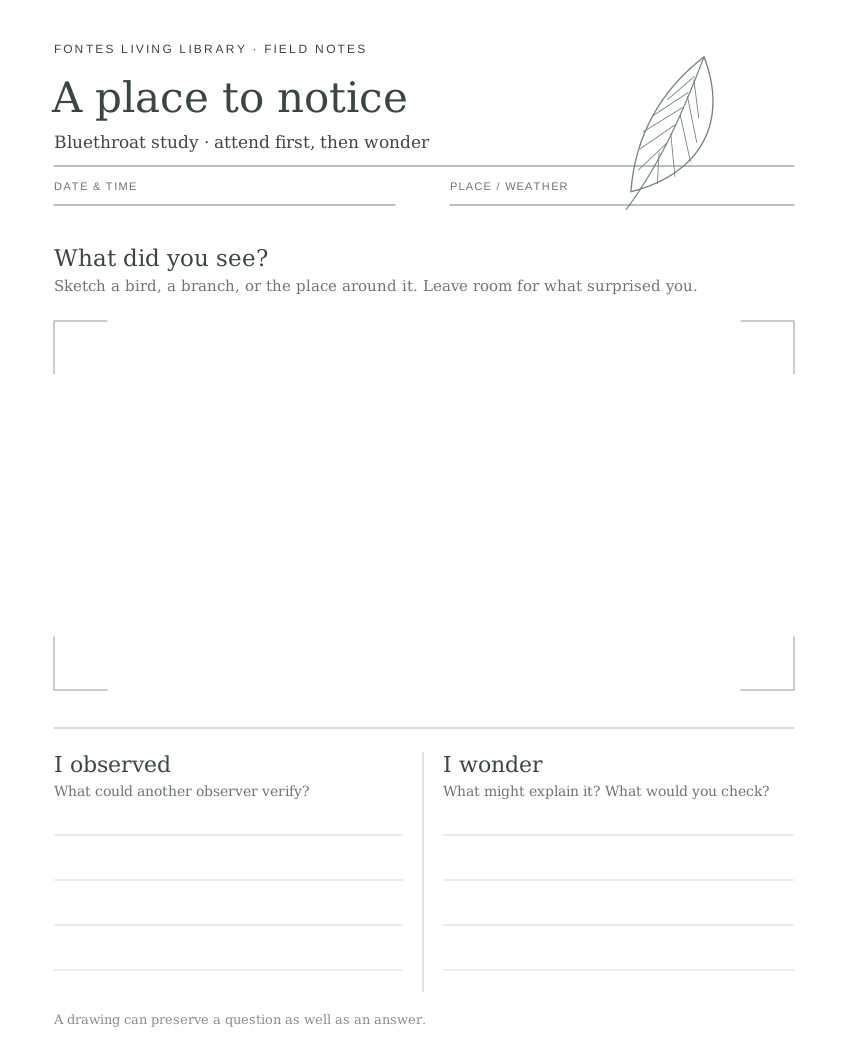
You do not need to travel into Bluethroat country. Choose a local bird and investigate one safe, familiar place. Bring a paper journal, pencil, watch, and optional binoculars. An adult should accompany younger learners.
Younger learners can draw three discoveries and narrate them aloud. Older learners can compare observation counts and explain the limits of their sample. Keep away from nests, do not handle birds or eggs, and stop if an animal changes its behavior because of your presence.
Field guides open the door. Research papers show how knowledge is made.
Research reviewed October 13, 2026. This original educational synthesis distinguishes general accounts from particular experiments and tracks. Regional differences matter. The sources below support the numbered references throughout the study; media licenses are credited beside each asset.
Photographs and identification clues, including differences between males, females, and young birds.
North American habitat, feeding methods, nest construction, clutch size, and condition at hatching.
Kenn Kaufman’s account of song, display, habitat, nesting, and parental care. Compare its regional emphasis with other sources.
Classification and breeding statistics. Useful for comparing incubation and fledging estimates across references.
Arizaga, García, and Suárez-Seoane’s Spanish-language synthesis (2016): plumage, regional habitat, feeding, and breeding. Its older migration uncertainties should be read alongside newer tracking papers.
A controlled experiment investigating female responses to changes in male ultraviolet throat ornamentation.
Ultraviolet plumage, social mate choice, and sperm competition. An advanced extension connecting visual signals and reproduction.
Recovered geolocator tracks from four European males, with wintering regions in India and Pakistan. Full text may require access through the publisher or an institutional repository.
One recovered logger, a suggested Myanmar winter area, and a careful discussion of data limitations.
A complete track from a central Siberian male, possible stopovers, and uncertainty around the location of a migratory divide.
Research from western France on breeding performance, timing, and nest failure. These findings concern a particular studied population.
A documented Booted Eagle prey record in Spain. A regional example, not a complete worldwide predator list.
How representative are the few tracked birds of their wider populations? Where exactly is the proposed migratory divide in Siberia? How do local food supply, habitat, and predation change breeding outcomes? These questions are part of the subject, not loose ends to hide.