
Meet the living subject or observe the natural phenomenon first. Ask a few questions aloud and give students time to discover what observation can answer. Leave the unanswered questions for later research. A sketch or written narration belongs in a paper nature journal.
This historical lesson is reproduced as a source, not as current animal-care, collecting, medical, or experiment advice. Observe wildlife without disturbing it, follow local rules, and check present-day safety guidance before any hands-on work. Never look directly at the Sun.
01How to use this lessonA short field guide for the adult
Let the subject lead.
Read the teacher material in advance if possible. During observation, select only the questions the student can investigate today. Do not answer on the student’s behalf while there is still something to see, hear, compare, or measure safely. Afterward, invite an oral narration or a picture in a paper nature journal. Discuss remaining questions only once observation is complete.
02The teacher’s readingComstock’s original preparatory text
The teacher’s reading
Text from the original handbook. Page markers are omitted; layout is adapted for reading. The source may reflect 1911 knowledge and practices.
Teacher’s Story
BLITHE and mellow is the ringing “ank, ank” note of the nuthatch, and why need we allude to its nasal timbre! While it is not a strictly musical note, it has a most enticing quality and translates into sound the picture of bare-branched trees and the feeling of enchantment which permeates the forest in winter; it is one of the most “woodsy” notes in the bird repertoire. And while the singer of this note is not so bewitching as his constant chum the chickadee, yet it has many interesting ways quite its own. Nor is this “ank, ank,” its only note. I have often heard a pair talking to each other in sweet confidential syllables, “wit, wit, wit” very different from the loud note meant for the world at large. The nuthatches and chickadees hunt together all winter; it is no mere business partnership but a matter of congenial tastes. The chickadees hunt over the twigs and smaller branches, while the nuthatches usually prefer the tree trunks and the bases of the branches; both birds like the looks of the world upside down, and while the chickadee hangs head down from a twig, the nuthatch is quite likely to alight head down on a tree bole, holding itself safely in this position by thrusting its toes out at right angles to the body, thus getting a firm hold upon the bark. Sometimes its foot will be twisted completely around, the front toes pointed up the tree. The foot is well adapted for clinging to the bark as the front toes are strong and the hind toe is very long and is armed with a strong claw. Thus equipped, this bird runs about on the tree so rapidly, it has earned the name of “tree mouse”. It often ascends a tree trunk spirally but is not so hidebound in this habit as is the brown creeper. It runs up or down freely head first and never flops down backwards like a woodpecker.
In color the nuthatch is bluish gray above with white throat and breast and reddish underparts. The sides of the head are white; the black cap extends back upon the neck but is not “pulled down” to the eyes like the chickadees. The wing feathers are dark brown edged with pale gray. The upper middle tail feathers are bluish like the back; the others are dark brown and tipped with white in such a manner that the tail when spread shows a broad white border on both sides. The most striking contrast between the chickadee and nuthatch in markings is that the latter lacks the black bib. However, its entire shape is very different from that of the chickadee and its beak is long and slender, being as long or longer than its head, while the beak of the chickadee is a short, sharp, little pick. The bill of the nuthatch is exactly fitted to reach in crevices of the bark and pull out hiding insects, or to hammer open the shell of nut or acorn and get both the meat of the nut and the grub feeding upon it. It will wedge an acorn into a seam in the bark and then throw back its head, woodpecker fashion, and drive home its chisel beak. But it does not always use common sense in this habit. I have often seen one cut off a piece of suet, fly off and thrust it into some crevice and hammer it as hard as if it were encased in a walnut shell. This always seems bad manners, like carrying off fruit from table d’hote; but the nuthatch is polite enough in using a napkin, for after eating the suet, it invariably wipes its bill on a branch, first one side then the other most assiduously until it is perfectly clean.
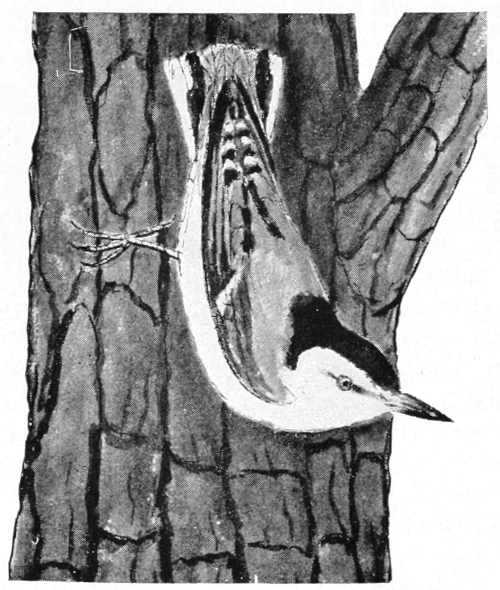
The white breasted nuthatch.
The nuthatches are a great benefit to our trees in winter, for then is when they hunt for hiding pests on their trunks. Their food consists of beetles, caterpillars, pupæ of various insects, also seeds of ragweed, sunflowers, acorns, etc. While the nuthatch finds much of its food on trees, yet Mr. Torrey has seen it awkwardly turning over fallen leaves hunting for insects, and Mr. Baskett says it sometimes catches insects on the wing and gets quite out of breath from this unusual exercise.
It is only during the winter that we commonly see the nuthatches, for during the nesting season, they usually retire to the deep woods where they may occupy a cavity in a tree used by a woodpecker last year, or may make a hole for themselves with their sharp beaks. The nest is lined with leaves, feathers and hair; from five to nine creamy, speckled eggs are the treasure of this cave.
03The original lesson and questionsTake these to the subject itself
Questions to explore
Choose what fits this encounter. Some original prompts ask for collecting, handling, or other historical activities; use a safe observation instead. Write or draw only in a paper nature journal.
The Nuthatch
Leading thought—The nuthatch is often a companion of the chickadees and woodpeckers. It has no black bib, like the chickadee, and it alights on a tree trunk head downward, which distinguishes it from woodpeckers.
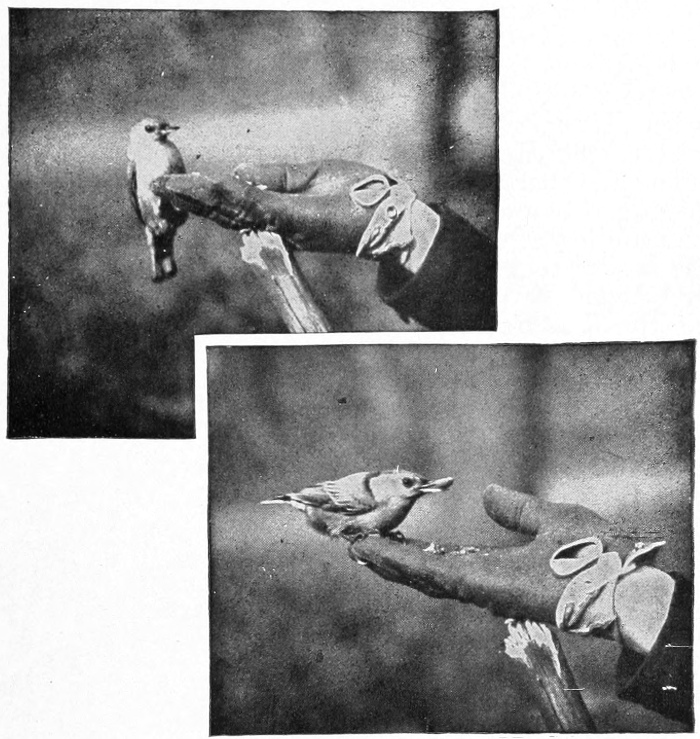
Methods—This bird, like the chickadee and downy, gladly shares the suet banquet we prepare for them and may be observed at leisure while “at table.” The contrast between the habits of the nuthatch and those of its companions make it a most valuable aid in stimulating close and keen observation on the part of the pupils.
Observations—1. Where have you seen the nuthatches? Were they with other birds? What other birds?
2. Does a nuthatch usually alight on the ends of the branches of a tree or on the trunk and larger limbs? Does it usually alight head down or up? When it runs down the tree, does it go head first or does it back down? When it ascends the tree does it follow a spiral path? Does it use its tail for a brace when climbing, as does the downy?
3. How are the nuthatch’s toes arranged to assist it in climbing? Are the three front toes of each foot directed downward when the bird alights head downward? How does it manage its feet when in this position?
4. What is the general color of the nuthatch above and below? The color of the top and sides of head? Color of Back? Wings? Tail? Throat? Breast?
5. Does the black cap come down to the eyes on the nuthatch as on the chickadee? Has the nuthatch a black bib?
6. What is the shape of the beak of the nuthatch? For what is it adapted? How does it differ from the beak of the chickadee?
7. What is the food of the nuthatch? Where is it found? Does it open nuts for the grubs or the nut meat? Observe the way it strikes its beak into the suet, why does it strike so hard?
8. How would you spell this bird’s note? Have you heard it give more than one note?
9. How does the nuthatch benefit our trees? At what season does it benefit them most? Why?
10. Where do the nuthatches build their nests? Why do we see the nuthatches oftener in winter than in summer?
Comstock, Handbook of Nature-Study, Lesson XII. Read the illustrated original at Project Gutenberg. Public domain in the United States.