
Meet the living subject or observe the natural phenomenon first. Ask a few questions aloud and give students time to discover what observation can answer. Leave the unanswered questions for later research. A sketch or written narration belongs in a paper nature journal.
This historical lesson is reproduced as a source, not as current animal-care, collecting, medical, or experiment advice. Observe wildlife without disturbing it, follow local rules, and check present-day safety guidance before any hands-on work. Never look directly at the Sun.
01How to use this lessonA short field guide for the adult
Let the subject lead.
Read the teacher material in advance if possible. During observation, select only the questions the student can investigate today. Do not answer on the student’s behalf while there is still something to see, hear, compare, or measure safely. Afterward, invite an oral narration or a picture in a paper nature journal. Discuss remaining questions only once observation is complete.
02The teacher’s readingComstock’s original preparatory text
The teacher’s reading
Text from the original handbook. Page markers are omitted; layout is adapted for reading. The source may reflect 1911 knowledge and practices.
Teacher’s Story
COCKROACHES in our kitchens are undoubtedly an unmitigated nuisance, and yet, as in many other instances, when we come to consider the individual cockroach, we find him an interesting fellow and exceedingly well adapted for living in our kitchens despite us.
In shape, the cockroach is flat, and is thus well adapted to slide beneath utensils and into crevices and corners. Its covering is smooth and polished like patent leather, and this makes it slippery and enables it to get into food without becoming clogged by the adherence of any sticky substance. The antennæ are very long and flexible and can be bent in any direction. They may be placed far forward to touch things which the insect is approaching, or may be placed over the back in order to be out of the way. They are like graceful, living threads, and the cockroach tests its whole environment with their aid. The mouth has two pairs of palpi or feelers, one of which is very long and noticeable; these are kept in constant motion as if to test the appetizing qualities of food. The mouth-parts are provided with jaws for biting and, like all insect jaws, these work sidewise instead of up and down. The eyes are black but not prominent or large, and seem to be merely a part of the sleek, polished head-covering.
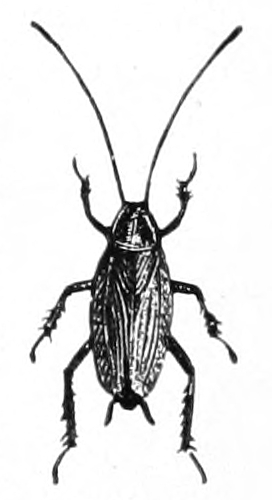
Croton bug.
Some species of cockroaches have wings, and some do not. Those which have wings, have the upper pair thickened and used for wing-covers. The under pair are thinner and are laid in plaits like a fan. The wing-covers are as polished as the body and quite as successful in shedding dirt.
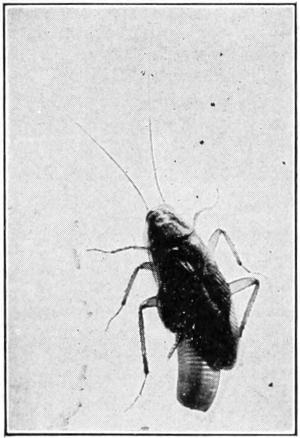
Cockroach laying her case of eggs.
Photo by M. V. Slingerland.
The legs are armed with long spines which are very noticeable and might prove to be a disadvantage in accumulating filth; but they are polished also; and too, this insect spends much time at its toilet.
Cockroaches run “like a streak”, children say; so speedily, indeed, do they go that they escape our notice, although we may be looking directly at them. This celerity in vanishing, saves many a cockroach from being crushed by an avenging foot.
When making its toilet, the cockroach draws its long antenna through its jaws as if it were a whiplash, beginning at the base and finishing at the tip. It cleans each leg by beginning near the body and so stroking downward the long spines which seem to shut against the leg. It nibbles its feet clean to the very claws, and scrubs its head vigorously with the front femur.
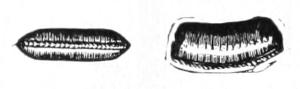
Egg-case of cockroach.
The cockroach’s eggs are laid in a mass enclosed in a pod-shaped covering, which is waterproof and polished and protects its contents from dampness. When the cockroaches, or the croton bugs, as the small introduced species of cockroach is called, once become established in a house, the only way to get rid of them is to fumigate the kitchen with carbon bisulphide which is a dangerous performance and should be done only by an expert.
03The original lesson and questionsTake these to the subject itself
Questions to explore
Choose what fits this encounter. Some original prompts ask for collecting, handling, or other historical activities; use a safe observation instead. Write or draw only in a paper nature journal.
The Cockroach
Leading thought—The cockroach is adapted for living in crevices, and although its haunts may be anything but clean, the cockroach keeps itself quite clean. The American species live in fields and woods and under stones and sticks and only occasionally venture into dwellings. The species that infest our kitchens and water-pipes are European.
Method—Place a cockroach in a vial with bread, potato or some other food, cork the vial, and pass it around so that the children may observe the prisoner at their leisure.
Observations—1. What is the general shape of the cockroach? Why is this an advantage? What is the texture of its covering? Why is this an advantage?
2. Describe the antennæ and the way they are used. Note the two little pairs of feelers at the mouth. If possible, see how they are used when the cockroach is inspecting something to eat. Can you see whether its mouth is fitted for biting, lapping or sucking its food?
3. Note the eyes. Are they as large and prominent as those of the bees or butterflies?
4. Has this cockroach wings? If so, how many and what are they like? Note two little organs at the end of the body. These are the cerci, like those of the crickets.
5. Describe the general appearance of the cockroach’s legs, and tell what you think about its ability as a runner.
6. Note how the cockroach cleans itself and how completely and carefully this act is performed. Have you ever seen cockroach’s eggs? If so, describe them.
7. How can you get rid of cockroaches if they invade your kitchen?
Comstock, Handbook of Nature-Study, Lesson LXXXIII. Read the illustrated original at Project Gutenberg. Public domain in the United States.