
Meet the living subject or observe the natural phenomenon first. Ask a few questions aloud and give students time to discover what observation can answer. Leave the unanswered questions for later research. A sketch or written narration belongs in a paper nature journal.
This historical lesson is reproduced as a source, not as current animal-care, collecting, medical, or experiment advice. Observe wildlife without disturbing it, follow local rules, and check present-day safety guidance before any hands-on work. Never look directly at the Sun.
01How to use this lessonA short field guide for the adult
Let the subject lead.
Read the teacher material in advance if possible. During observation, select only the questions the student can investigate today. Do not answer on the student’s behalf while there is still something to see, hear, compare, or measure safely. Afterward, invite an oral narration or a picture in a paper nature journal. Discuss remaining questions only once observation is complete.
02The teacher’s readingComstock’s original preparatory text
The teacher’s reading
Text from the original handbook. Page markers are omitted; layout is adapted for reading. The source may reflect 1911 knowledge and practices.
Teacher’s Story
PROTECTING her eggs from the vicissitudes of the weather seems to be the spider mother’s chief care; though at the same time and by the same means, she protects them from the attacks of predacious insects. Many of the species make silken egg-sacs, which are often elaborate in construction, and are carefully placed in protected situations.
Often a little silvery disk may be seen attached to a stone in a field. It resembles a circular lichen on the stone, but if it is examined it is found to consist of an upper, very smooth, waterproof coat, while below is a soft, downy nest, completely enfolding the spider’s eggs.
The egg-sacs of the cobweb weavers are often found suspended in their webs. One of the large orbweavers makes a very remarkable nest, which it attaches to the branches of weeds or shrubs. This sac is about as large as a hickory nut, and opens like a vase at the top. It is very securely suspended by many strong threads of silk, so that the blasts of winter cannot tear it loose. The outside is shining and waterproof, while inside it has a fit lining for a spiderling cradle.
Dr. Burt G. Wilder studied the development of the inmates of one of these nests by cutting open different nests at different periods of the winter. In the autumn, the nest contained five hundred or more eggs. These eggs hatched in early winter but it seemed foreordained that some of the little spiders were born for food for their stronger brethren. They seemed resigned to their fate, for when one of these victims was seized by its cannibalistic brother, it curled up its legs and submitted meekly. The result of this process was that, out of the five hundred little spiders hatched from the eggs, only a few healthy and apparently happy young spiders emerged from the nest in the spring, sustained by the nourishment afforded them by their own family, and fitted for their life in the outside world.
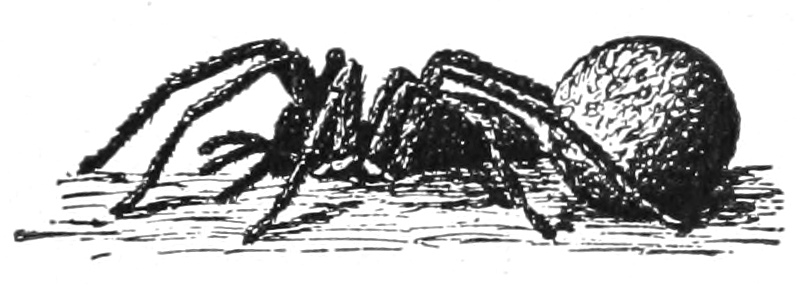
A wolf-spider carrying her egg-sac.
Some spiders make a nest for their eggs within folded leaves, and some build them in crevices of rocks and boards.
The running spiders, which are the large ones found under stones, make globular egg-sacs; the mother spider drags after her this egg-sac attached to her spinnerets; the young, when they hatch, climb upon their mother’s back, and there remain for a time.
03The original lesson and questionsTake these to the subject itself
Questions to explore
Choose what fits this encounter. Some original prompts ask for collecting, handling, or other historical activities; use a safe observation instead. Write or draw only in a paper nature journal.
The Nests of Spiders
Leading thought—The spider mothers have many interesting ways of protecting their eggs, which they envelop in silken sacs and place in safety.
Method—Ask the pupils to bring in all the spider egg-sacs that they can find. Keep some of them unopened, and open others of the same kind, and thus discover how many eggs are in the sac, and how many spiderlings come out. This is a good lesson for September and October.
Observations—1. In what situation did you find the nest? How was it protected from rain and snow? To what was it attached?
2. Of what texture is the outside of the sac? Is the outside made of waterproof silk? What is the texture of the lining?
3. How many eggs in this sac? What is the color of the eggs? When do the spiderlings hatch? Do as many spiders come out of the sac as there were eggs? Why is this?
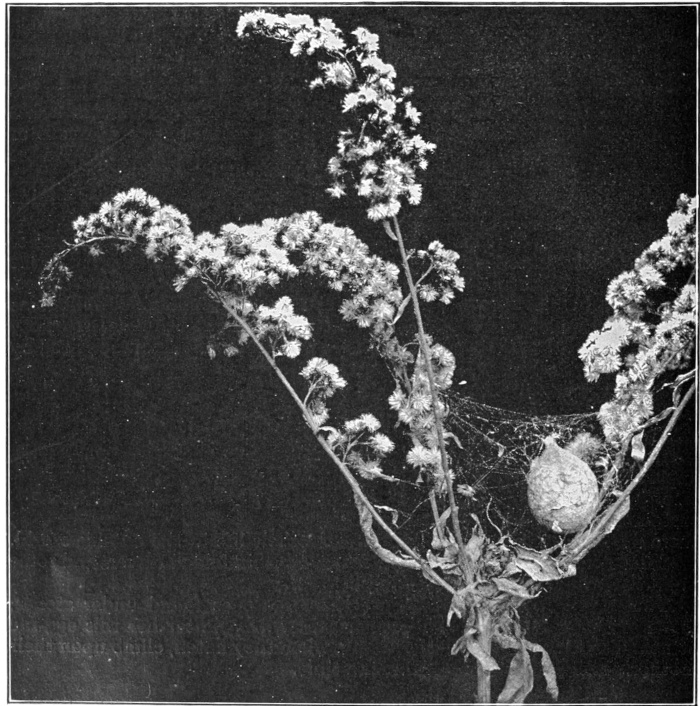
The egg-sac of the large, black and yellow garden-spider suspended for the winter in a branch of golden-rod.
Photo by Slingerland.
Comstock, Handbook of Nature-Study, Lesson CXVI. Read the illustrated original at Project Gutenberg. Public domain in the United States.