
Meet the living subject or observe the natural phenomenon first. Ask a few questions aloud and give students time to discover what observation can answer. Leave the unanswered questions for later research. A sketch or written narration belongs in a paper nature journal.
This historical lesson is reproduced as a source, not as current animal-care, collecting, medical, or experiment advice. Observe wildlife without disturbing it, follow local rules, and check present-day safety guidance before any hands-on work. Never look directly at the Sun.
01How to use this lessonA short field guide for the adult
Let the subject lead.
Read the teacher material in advance if possible. During observation, select only the questions the student can investigate today. Do not answer on the student’s behalf while there is still something to see, hear, compare, or measure safely. Afterward, invite an oral narration or a picture in a paper nature journal. Discuss remaining questions only once observation is complete.
02The teacher’s readingComstock’s original preparatory text
The teacher’s reading
Text from the original handbook. Page markers are omitted; layout is adapted for reading. The source may reflect 1911 knowledge and practices.
Teacher’s Story
These beautiful, showy flowers have rich contrasts in their color scheme. The ten to twenty ray flowers wave rich, orange banners around the cone of purple-brown disk-flowers. The banners are notched and bent downward at their tips; each banner-flower has a pistil, and develops a seed. The disk-flowers are arranged in a conical, button-like center; the corollas are pink-purple at the base of the tube, but their five recurved, pointed lobes are purple-brown. The anther-tube is purple-brown and the stigmas show the same color; but the pollen is brilliant orange, and adds much to the beauty of the rich, dark florets when it is pushed from the anther-tubes. There is no pappus developed, and the seeds are carried as are the seeds of the white daisy, by being harvested with the seeds of grain.
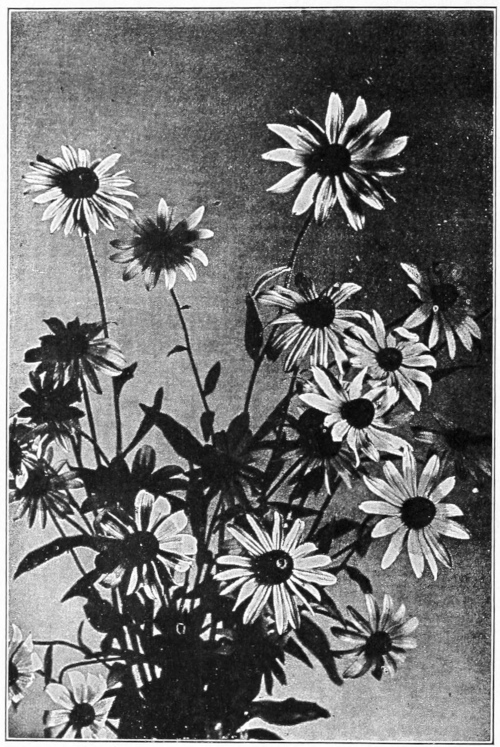
The stem is strong and erect; the bracts of the involucre, or “shingles”, are long, narrow and hairy, the lower ones being longer and wider than those above; they all spread out flat, or recurve below the open flower-head. In blossoming, first the ray-flowers spread wide their banners; then the flowerets around the base of the cone open and push out their yellow pollen through the brown tubes; then day by day the blossoming circle climbs toward the apex—a beautiful way of blossoming upward.
03The original lesson and questionsTake these to the subject itself
Questions to explore
Choose what fits this encounter. Some original prompts ask for collecting, handling, or other historical activities; use a safe observation instead. Write or draw only in a paper nature journal.
The Black-Eyed Susan
Leading thought—This flower should be studied by the outline given in Lesson CXXXV.
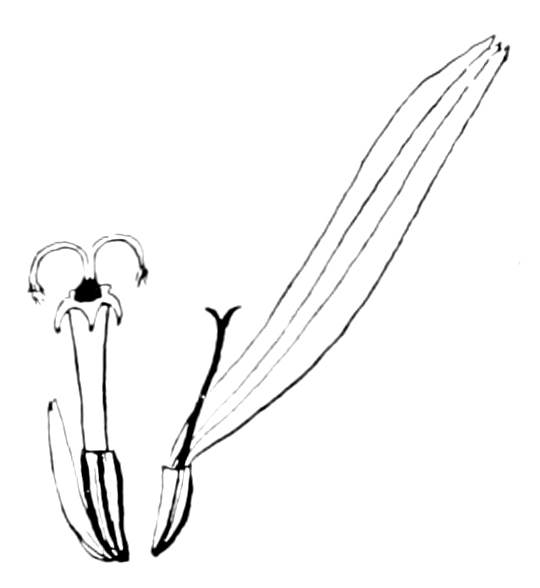
Disk-flower and ray-flower.
Comstock, Handbook of Nature-Study, Lesson CXXXIX. Read the illustrated original at Project Gutenberg. Public domain in the United States.