
Meet the living subject or observe the natural phenomenon first. Ask a few questions aloud and give students time to discover what observation can answer. Leave the unanswered questions for later research. A sketch or written narration belongs in a paper nature journal.
This historical lesson is reproduced as a source, not as current animal-care, collecting, medical, or experiment advice. Observe wildlife without disturbing it, follow local rules, and check present-day safety guidance before any hands-on work. Never look directly at the Sun.
01How to use this lessonA short field guide for the adult
Let the subject lead.
Read the teacher material in advance if possible. During observation, select only the questions the student can investigate today. Do not answer on the student’s behalf while there is still something to see, hear, compare, or measure safely. Afterward, invite an oral narration or a picture in a paper nature journal. Discuss remaining questions only once observation is complete.
02The teacher’s readingComstock’s original preparatory text
The teacher’s reading
Text from the original handbook. Page markers are omitted; layout is adapted for reading. The source may reflect 1911 knowledge and practices.
Teacher’s Story
For the intricate structure of this type of flower, the bleeding heart is much more easily studied than its smaller wild sisters, the Dutchman’s breeches or squirrel corn; therefore it is well to study these flowers when we find them in profusion in our gardens, and the next spring we may study the wildwood species more understandingly.
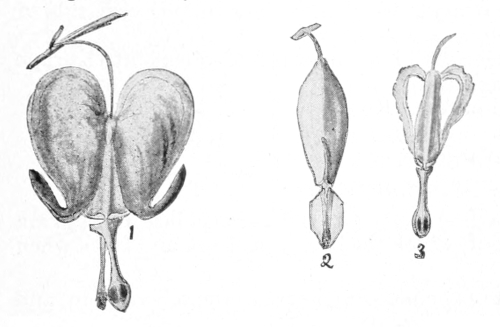
1, Flower of bleeding heart with swing-door ajar. 2, Side-view of flower showing the broad tips of the inner petals. 3, Flower with outer petals removed showing inner petals—and the heart-shaped bases of the stamens.
The flowers of the bleeding heart are beautiful jewel-like pendants arranged along the stem according to their age; the mature flower, ready to shed its petals, is near the main stem, while the tiny unopened bud is hung at the very tip, where new buds are constantly being formed during a long season of bloom. This flower has a strange modification of its petals; the two pink outer ones, which make the heart, are really little pitchers with nectar at their bottoms, and although they hang mouth downwards the nectar does not flow out. When these outer petals are removed, we can see the inner pair placed opposite to them, the two of them close together and facing each other like two grooved ladles. Just at the mouth of the pitchers these inner petals are almost divided crosswise; and the parts that extend beyond are spoon-shaped, like the bowls of two spoons which have been pinched out so as to make a wide, flat ridge along their centers. These spoon-bowls unite at the tip, and between them they clasp the anthers and stigma. Special attention should be given to the division between the two portions of these inner petals; for it is a hinge, the workings of which are of much importance to the flower. On removing the outer petals, we find a strange framework around which the heart-shaped part of the flower seems to be modeled. These are filaments of the stamens grouped in threes on each side; the two outer ones of each group are widened into frills on the outer edge, while the central one is stiffer and narrower. At the mouth of the pitchers all these filaments unite in a tube around the style; near the stigma they split apart into six short, white, threadlike filaments, each bearing a small, brilliant yellow anther. So close together are these anthers that they are completely covered by the spoon-bowls made by the inner petals, the pollen mass being flat and disklike. During the period when the pollen is produced, the stigma is flat and immature; but after the pollen is shed, it becomes rounded into lobes ready to receive pollen from other flowers.
Although the description of the plant of this flower is most complex and elaborate, the workings of the flower are most simple. As the nectar-pitchers hang mouth down, the bee must cling to the flower while probing upward. In doing this she invariably pushes against the outside of the spoon-bowls, and the hinge at their base allows her to push them back while the mass of pollen is thrust against her body; as this hinge works both ways, she receives the pollen first on one side and then on the other, as she probes the nectar-pitchers. And perhaps the next flower she visits may have shed its pollen, and the swing door will uncover the ripe stigma ready to receive the pollen she brings.
The sepals are two little scales opposite the bases of the outer petals. Before the flower opens, the “spouts of the nectar-pitchers” are clamped up on either side of the spoon-bowls, as if to keep everything safe until the right moment comes; at first they simply spread apart, but later curve backward. The seed-pod is long and narrow, and in cross-section is seen to contain two compartments with seeds growing on every side of the partition.
The bleeding heart is a native of China, and was introduced into Europe about the middle of the last century.
Reference—Our Garden Flowers, Keeler.
03The original lesson and questionsTake these to the subject itself
Questions to explore
Choose what fits this encounter. Some original prompts ask for collecting, handling, or other historical activities; use a safe observation instead. Write or draw only in a paper nature journal.
The Bleeding Heart
Leading thought—The bleeding heart flower has its pollen and stigma covered by a double swing door, which the bees push back and forth when they gather the nectar.
Method—Bring a bouquet of the bleeding heart to the schoolroom, and let each pupil have a stem with its flowers in all stages. From this study, encourage them to watch these flowers when the insects are visiting them.
Observations—1. How are these flowers supported? Do they open upward or downward? Can you see the tiny sepals?
2. How many petals can you see in this flower? What is the shape of the two outer petals? How do they open? Where is the nectar developed in these petals?
3. Take off the two outer petals and study the two inner ones. What is their shape near the base? How are their parts shaped which project beyond the outer petals? What does the spoon-end of these petals cover? Can you find the hinge in these petals?
4. Where are the stamens? How many are there? Describe the shape of the stamens near the base. How are they united at the tip?
5. Where is the stigma? The style? The ovary?
6. Supposing a bee is after the nectar, where must she rest while probing for it? Can she get the nectar without pushing against the flat projecting portion of the inner petals? When she pushes these spoon-bowls back, what happens? Does she get dusted with pollen? After she leaves, does the door swing back? Suppose she visits another flower which has shed its pollen, will she carry pollen to its stigma? Does she have to work the hinged door to do this?
THE POPPIES
Teacher’s Story
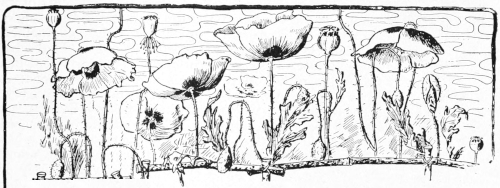
PERHAPS we might expect that a plant which gives strange dreams to those who eat of its juices should not be what it seems in appearance. I know of nothing so deceptive as the appearance of the poppy buds, which, rough and hairy, droop so naturally that it seems as if their weight must compel the stem to bend; and yet, if we test it, we find the stem is as stiff as if made of steel wire. Moreover, the flower and the ripened seed-capsule must be far heavier than the bud; and yet, as soon as the flower is ready to open, the stem straightens up, although it does not always remove the traces of the crook; and after the capsule is full of ripened seed, the stem holds it up particularly stiff, as if inviting the wind to shake out the seeds.
The rough covering of the bud consists of two sepals, as can be easily seen; but if we wish to see the poppy shed its sepals, we must get up in the morning, for the deed is usually done as soon as the first rays of the early sun bring their message of a fair day. The sepals break off at their base and fall to the ground. The two opposite outer petals unfold, leaving the two inner petals standing erect and on guard about the precious pollen, until the sunshine folds them back. An open poppy, when looked at below, shows two petals, each semicircular, and overlapping each other slightly; looked at from above, we see two petals, also half circles, set at right angles to the lower two, and divided from each other by the pistil.
The pistil of the poppy is, from the beginning, a fascinating box. At first, it is a vase with a round, circular cover, upon which are ridges, placed like the spokes of a wheel. If these ridges are looked at with a lens, particles of pollen may be seen adhering to them; this fact reveals the secret that each ridge is a stigma, and all of these radiating stigmas are joined so as better to catch the pollen. In a circle of fringe about the pistil are the stamens. In the study of the stamens, we should note whether their filaments expand or dilate near the anthers, and we should also note the color of the masses of pollen which crowd out from the anthers.
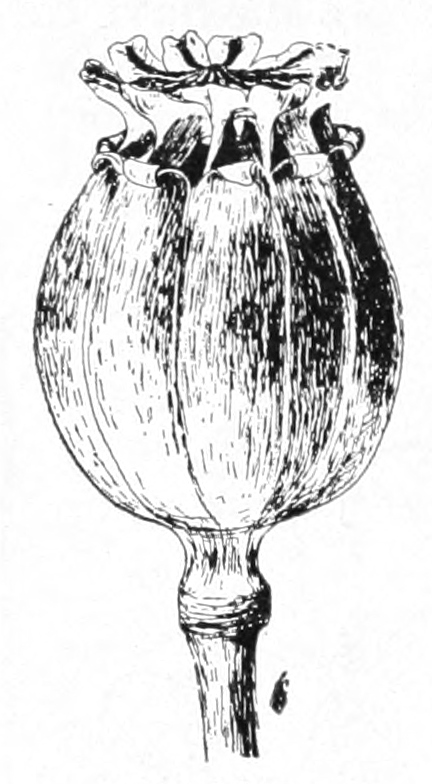
The poppy seed-shaker.
Drawn by Anna C. Stryke.
Despite the many varieties of poppies, there are only four species commonly cultivated. The opium poppy has upon its foliage a white bloom, the filaments of its stamens are dilated at the top, and its seed-capsule is smooth. The oriental poppy has all of these characters, except that its foliage is green and not covered with bloom. Its blossom is scarlet and very large and has a purple center in the petals and purple stamens; it has three sepals. Its flower stalks are stout and leafy. The corn poppy, which grows in the fields of Europe, is a weed we gladly cultivate. This, naturally, has red petals and is dark at the center of the flower; but it has been changed by breeding until now we have many varieties. Its foliage is finely cut and very bristly or hairy. Its seed-capsule is not bristly. To see this poppy at its best, we should visit northern Italy or southern France in late May, where it makes the grain fields gorgeous. This is the original parent of all the Shirley poppies. The Arctic, or Iceland poppy, has flowers of satiny texture and finely crumpled; its colors are yellow, orange or white, but never scarlet like the corn poppy; it has no leaves on its flower stem, and its seed-capsule is hairy. Of these four species, the opium poppy and the corn poppy are annuals, while the Arctic and the Oriental species are perennials.
The bees are over-fond of the poppy pollen and it is a delight to watch the fervor with which they simply wallow in it, brushing off all of the grains possible onto their hairy bodies. I have often seen a honey-bee seize a bunch of the anthers and rub them against the under side of her body, meanwhile standing on her head in an attitude of delirious joy. As showing the honey-bee’s eye for color, I have several times seen a bee drop to the ground to examine a red petal which had fallen. This was plain evidence that she trusted to the color to guide her to the pollen.
But perhaps it is the development of the poppy seed-capsule which we find the most interesting of the poppy performances. After fertilization, the stigma-disk develops a scalloped edge, a stigma rounding out the point of each scallop; and a sharp ridge, which continues the length of the globular capsule, runs from the center of each scallop. If examined on the inside, it will be seen that the ridge on the capsule is the edge of a partition which extends only part way toward the center of the capsule. On these partitions, the little seeds are grown in great profusion, and when they ripen, they fall together in the hollow center of the seed-box. But how are they to get out? This is a point of interest for the children to observe, and they should watch the whole process. Just beneath the stigma-disk, and between each two of the sharp ridges, the point loosens; later, it turns outward and back, leaving a hole which leads directly into the central hollow portion of the capsule. The way these points open is as pretty a story as I know in flower history. This beautiful globular capsule, with its graceful pedestal where it joins the stem, is a seed-shaker instead of a salt or pepper-shaker. Passing people and animals push against it and the stiff stem bends and then springs back, sending a little shower of seeds this way and that; or a wind sways the stalk, and the seeds are sown, a few at a time, and in different conditions of season and weather. Thus, although the poppy puts all her eggs in one basket, she sends them to market a few at a time. The poppy seed is a pretty object, as seen through the lens. It is shaped like a round bean, and is covered with a honeycomb network.
Comstock, Handbook of Nature-Study, Lesson CLIV. Read the illustrated original at Project Gutenberg. Public domain in the United States.