
Meet the living subject or observe the natural phenomenon first. Ask a few questions aloud and give students time to discover what observation can answer. Leave the unanswered questions for later research. A sketch or written narration belongs in a paper nature journal.
This historical lesson is reproduced as a source, not as current animal-care, collecting, medical, or experiment advice. Observe wildlife without disturbing it, follow local rules, and check present-day safety guidance before any hands-on work. Never look directly at the Sun.
01How to use this lessonA short field guide for the adult
Let the subject lead.
Read the teacher material in advance if possible. During observation, select only the questions the student can investigate today. Do not answer on the student’s behalf while there is still something to see, hear, compare, or measure safely. Afterward, invite an oral narration or a picture in a paper nature journal. Discuss remaining questions only once observation is complete.
02The teacher’s readingComstock’s original preparatory text
The teacher’s reading
Text from the original handbook. Page markers are omitted; layout is adapted for reading. The source may reflect 1911 knowledge and practices.
This lesson has no separate teacher story. Read Comstock’s introduction and method in the original lesson below before meeting the subject.
03The original lesson and questionsTake these to the subject itself
Questions to explore
Choose what fits this encounter. Some original prompts ask for collecting, handling, or other historical activities; use a safe observation instead. Write or draw only in a paper nature journal.
Salvia, or Scarlet Sage
Leading thought—This flower has the bracts and calyx scarlet instead of green, and this makes it a brilliant mass of color to please our eyes and attract the pollen-carrying insects. Its anthers are arranged at the tip of two levers, which the insects push up and down as they enter the flower, thus becoming dusted with pollen.
Method—The structure of this flower may be studied in the schoolroom and its mechanism there understood; but the most important part of the lesson is the observation out-of-doors upon the way the bees work the stamen levers when seeking the nectar. This is best observed during late September or October, after other flowers are mostly gone, and when the bees are working with frantic haste to get all the honey possible.
Observations—1. How does the calyx of the salvia differ from that of other flowers in color? How does it differ from the corolla in texture? How many lobes has it? How are they placed about the corolla?
2. What is the shape of the corolla? How does it make a hood over the entrance to the tube? What does the hood hold? Is there any platform made by the lower lip of the corolla for a visiting insect to alight upon?
3. Cut open one side of the corolla and describe how the stamens are arranged. Thrust your pencil into an uninjured flower and see if the anthers in the hood are moved by it. How? Describe how a bee in visiting this flower moves the anthers so as to become dusted with pollen.
4. Where is the stigma? How does it receive pollen from visiting insects? Would it be likely to get the pollen which has just been scraped off from its own anthers by the bee? Why?
5. Experiment to find where the nectar is. Do you ever see bees getting the nectar from fallen flowers? Do they get it from the “front” or the “back door?”
6. What other parts of this flower are red, which in other flowers are green? How does this make the budding portions of the flower stem look? Why does this make the salvia a more beautiful plant for our gardens?
7. Compare the mechanism of the stamens of the scarlet sage with the mechanism of the stamens of the common garden sage.
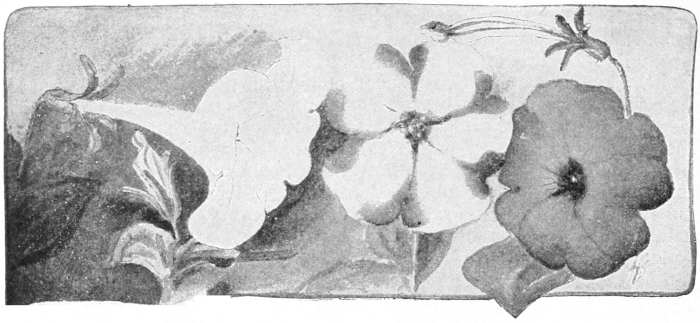
Drawn by Anna C. Stryke.
Comstock, Handbook of Nature-Study, Lesson CLXII. Read the illustrated original at Project Gutenberg. Public domain in the United States.