
Meet the living subject or observe the natural phenomenon first. Ask a few questions aloud and give students time to discover what observation can answer. Leave the unanswered questions for later research. A sketch or written narration belongs in a paper nature journal.
This historical lesson is reproduced as a source, not as current animal-care, collecting, medical, or experiment advice. Observe wildlife without disturbing it, follow local rules, and check present-day safety guidance before any hands-on work. Never look directly at the Sun.
01How to use this lessonA short field guide for the adult
Let the subject lead.
Read the teacher material in advance if possible. During observation, select only the questions the student can investigate today. Do not answer on the student’s behalf while there is still something to see, hear, compare, or measure safely. Afterward, invite an oral narration or a picture in a paper nature journal. Discuss remaining questions only once observation is complete.
02The teacher’s readingComstock’s original preparatory text
The teacher’s reading
Text from the original handbook. Page markers are omitted; layout is adapted for reading. The source may reflect 1911 knowledge and practices.
Teacher’s Story
Of all “plant babies,” that of the fern is most cozily cuddled; one feels when looking at it, that not only are its eyes shut but its fists are tightly closed. But the first glance at one of these little woolly spirals gives us but small conception of its marvelous enfolding, all so systematic and perfect that it seems another evidence of the divine origin of mathematics. Every part of the frond is present in that bud, even to the fruiting organs; all the pinnæ and the pinnules are packed in the smallest compass—each division, even to the smallest pinnule, coiled in a spiral towards its base. These coiled fern buds are called crosiers; they are woolly, with scales instead of hairs, and are thus well blanketed. Some botanists object to the comparison of the woolly or fuzzy clothing of young plants with the blankets of human infants. It is true that the young plant is not kept at a higher temperature by this covering; but because of it, transpiration which is a cooling process is prevented, and thus the plant is kept warmer. When the fern commences to grow, it stretches up and seems to lean over backward in its effort to be bigger. First the main stem, or rachis, loosens its coil; but before this is completed, the pinnæ, which are coiled at right angles to the main stem, begin to unfold; a little later the pinnules, which are folded at right angles to the pinnæ, loosen and seem to stretch and yawn before taking a look at the world which they have just entered; it may be several days before all signs of the complex coiling disappear. The crosiers of the bracken are queer looking creatures, soon developing three claws which some people say look like the talons of an eagle; and so intricate is the action of their multitudinous spirals, that to watch them unfolding impresses one as in the presence of a miracle.
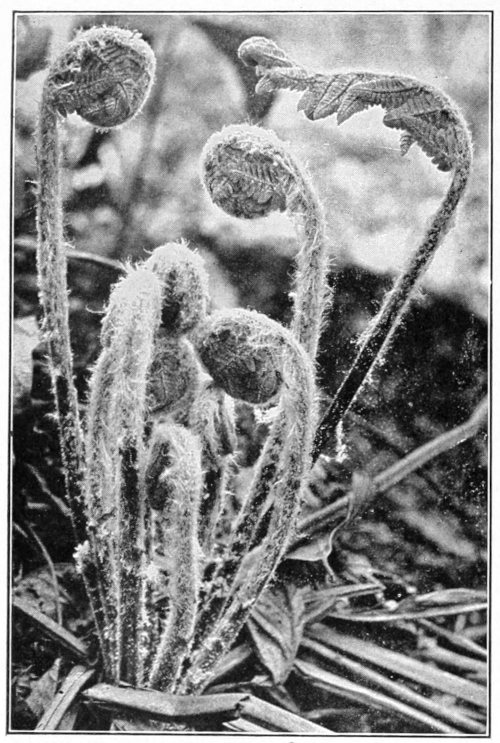
Fiddle heads, or crosiers. Young ferns unfolding.
Photo by Verne Morton.
03The original lesson and questionsTake these to the subject itself
Questions to explore
Choose what fits this encounter. Some original prompts ask for collecting, handling, or other historical activities; use a safe observation instead. Write or draw only in a paper nature journal.
How A Fern Bud Unfolds
Leading thought—All of the parts of the frond of a fern are tightly folded spirally within the bud, and every lobe of every leaflet is also folded in a spiral.
Method—The bracken crosier is a most illuminating object for this lesson, because it has so many divisions and is so large; it is also convenient, because it may be found in September. However, any fern bud will do. The lesson may be best given in May when the woodland ferns are starting. A fern root with its buds should be brought to the schoolroom, where the process of unfolding may be watched at leisure.
Observations—1. Take a very young bud. How does it look? Do you see any reason why ignorant people call these buds caterpillars? Can you see why they are popularly called “fiddle heads?” What is their true name? How many turns of the coil can you count? What is the covering of the crosier? Do you think this cover is a protection? How is the stem grooved to make the spiral compact?
2. Take a crosier a little further advanced. How are its pinnæ folded? How is each pinnule of each pinna folded? How is each lobe of a pinnule folded? Is each smaller part coiled toward each larger part?
3. Write in your note-book the story of the unfolding fern, and sketch its stages each day from the time it is cuddled down in a spiral until it is a fully expanded frond.
Comstock, Handbook of Nature-Study, Lesson CLXXV. Read the illustrated original at Project Gutenberg. Public domain in the United States.