
Meet the living subject or observe the natural phenomenon first. Ask a few questions aloud and give students time to discover what observation can answer. Leave the unanswered questions for later research. A sketch or written narration belongs in a paper nature journal.
This historical lesson is reproduced as a source, not as current animal-care, collecting, medical, or experiment advice. Observe wildlife without disturbing it, follow local rules, and check present-day safety guidance before any hands-on work. Never look directly at the Sun.
01How to use this lessonA short field guide for the adult
Let the subject lead.
Read the teacher material in advance if possible. During observation, select only the questions the student can investigate today. Do not answer on the student’s behalf while there is still something to see, hear, compare, or measure safely. Afterward, invite an oral narration or a picture in a paper nature journal. Discuss remaining questions only once observation is complete.
02The teacher’s readingComstock’s original preparatory text
The teacher’s reading
Text from the original handbook. Page markers are omitted; layout is adapted for reading. The source may reflect 1911 knowledge and practices.
Teacher’s Story
HOW pathetically the untidy bark of this dignified tree suggests the careless raiment of a great man! The shagbark is so busy being something worth while that it does not seem to have time or energy to clothe itself in tailor-made bark, like the beech, the white ash and the basswood. And just as we like a great man more because of his negligence to fashion’s demands, so do we esteem this noble tree, and involuntarily pay it admiring tribute as we note its trunk with the bark scaling off in long, thin plates that curve outward at the top and bottom and seem to be only slightly attached at the middle.
In general shape, the shagbark resembles the oak; the lower branches are large and, although rising as they leave the bole, their tips are deflected; and, for their whole length, they are gnarled and knotted as if to show their strength. The bark on the larger branches may be scaly toward their bases but above is remarkably smooth. The spray is angular and extends in almost every direction. The leaves, like those of other hickories, are compound. There are generally five leaflets, but sometimes only three and sometimes seven. The basal pair is smaller than the others. The hickory leaves are borne alternately on the twig, and from this character the hickory may be distinguished from the ashes, which have leaves of similar type, but which are placed opposite on the twigs. The shagbark usually has an unsymmetrical oblong head; the lower branches are usually shorter than the upper ones, and the latter are irregularly placed, causing gaps in the foliage.
The nut is large, with a thick, smooth, outer husk channeled at the seams and separating readily into sections; the inner shell is sharply angled and pointed and slightly flattened at the sides; the kernel is sweet. The winter buds of the shagbark are large, light brown, egg-shaped and downy; they swell greatly before they expand. There are from eight to ten bud-scales; the inner ones, which are red, increase to two or three inches in length before the leaves unfold, after which they fall away. The young branches are smooth, soft, delicate in color, and with conspicuous leaf scars.
The hickory bears its staminate and pistillate flowers on the same tree. The pollen-bearing flowers grow at the base of the season’s shoots in slender, pendulous, green catkins, which occur usually in clusters of three swinging from a common stem. The pistillate flowers grow at the tips of the season’s shoots singly or perhaps two or three on a common stem. In the shagbark the middle lobe of the staminate calyx is nearly twice as long as the other two, and is tipped with long bristles; it usually has four stamens with yellow anthers; its pistillate calyx is four-toothed and hairy, and has two large, fringed stigmas.
The big shagbark, or king nut, is similar to the shagbark in height, manner of growth, and bark. However, its leaves have from seven to nine leaflets, which are more oblong and wedgelike than are those of the shagbark; they are also more downy when young and remain slightly downy beneath. The nut is very large, thick-shelled, oblong, angled, and pointed at both ends. The kernel is large and sweet but inferior in flavor to the smaller shagbark. The big shagbark has larger buds than has the other. Their fringy, reddish purple, inner scales grow so large that they appear tuliplike before they fall away at the unfolding of the leaves.
Hickory wood ranks high in value; it is light-colored, close-grained, heavy, and very durable when not exposed to moisture. It is capable of resisting immense strain, and, therefore, it is used for the handles of spades, plows and other tools, and also for spokes and thills in carriage-making. As a fuel, it is superior to most woods, making a glowing, hot and quite lasting fire.
03The original lesson and questionsTake these to the subject itself
Questions to explore
Choose what fits this encounter. Some original prompts ask for collecting, handling, or other historical activities; use a safe observation instead. Write or draw only in a paper nature journal.
The Shagbark
Leading thought—The hickories are important trees commercially. They have compound leaves which are set alternately upon the twig. The shagbark can be told from the other hickories by its ragged, scaling bark.
Method—This lesson may be begun in the winter when the tree can be studied carefully as to its shape and method of branching. Later, the unfolding of the leaves from the large buds should be watched, as this is a most interesting process; and a little later the blossoms may be studied. The work should be taken up again in the fall, when the fruit is ripe.
Observations Winter study—1. What is the general shape of the whole tree? Are the lower branches very large? At what angle do the branches, in general, grow from the trunk? Are there many large branches?
2. Where is the spray borne? What is its character—that is, is it fine and smooth, or knotted and angled? What is its color?
3. Describe the bark. Is the bark on the limbs like that on the trunk?
4. What is the size and shape of the buds? Are the buds greenish-yellow, yellowish brown, or do they have a reddish tinge?
5. Count the bud-scales. Are they downy or smooth?
Spring study—6. Describe how the hickory leaf unfolds from its bud. How is each leaflet folded within the bud?
7. Describe the long greenish catkins which bear the pollen. On what part of the twigs do they grow? Do they grow singly or in clusters?
8. Take one of the tiny, pollen-bearing flowers and hold it under a lens on the point of a pin. How many lobes has the calyx? Count the stamens, and note the color of the anthers.
9. Upon what part of the twigs do the pistillate flowers grow? How many points or lobes has the pistillate calyx? Describe the growth of the nut from the flower.
Autumn study—10. Does the hickory you are studying grow in open field or wood?
11. Are the trunk and branches slender and lofty, or sturdy and wide spreading?
12. Note the number and shape of the leaflets. Are they slim and tapering, or do they swell to the width of half their length? Are they set directly upon or are they attached by tiny stems to the mid-stem? Are they smooth or downy on the under side? Are the leaves set upon the twigs alternately or opposite each other? How are the leaflets set upon the mid-stem?
13. Describe the outer husk of the nut. Into how many sections does it open? Does it cling to the nut and fall with it to the ground? Is the nut angled and pointed, or is it roundish and without angles? Is the kernel sweet or bitter?
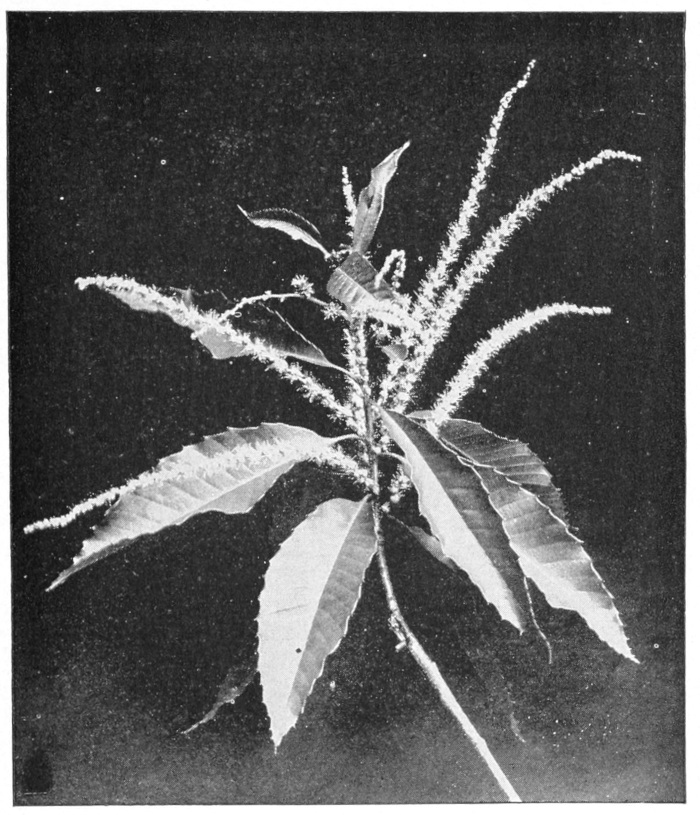
Photo by Verne Morton.
Chestnut blossoms.
Note the two pistillate flowers above the staminate catkins.
Comstock, Handbook of Nature-Study, Lesson CXCIII. Read the illustrated original at Project Gutenberg. Public domain in the United States.