
Meet the living subject or observe the natural phenomenon first. Ask a few questions aloud and give students time to discover what observation can answer. Leave the unanswered questions for later research. A sketch or written narration belongs in a paper nature journal.
This historical lesson is reproduced as a source, not as current animal-care, collecting, medical, or experiment advice. Observe wildlife without disturbing it, follow local rules, and check present-day safety guidance before any hands-on work. Never look directly at the Sun.
01How to use this lessonA short field guide for the adult
Let the subject lead.
Read the teacher material in advance if possible. During observation, select only the questions the student can investigate today. Do not answer on the student’s behalf while there is still something to see, hear, compare, or measure safely. Afterward, invite an oral narration or a picture in a paper nature journal. Discuss remaining questions only once observation is complete.
02The teacher’s readingComstock’s original preparatory text
The teacher’s reading
Text from the original handbook. Page markers are omitted; layout is adapted for reading. The source may reflect 1911 knowledge and practices.
This lesson has no separate teacher story. Read Comstock’s introduction and method in the original lesson below before meeting the subject.
03The original lesson and questionsTake these to the subject itself
Questions to explore
Choose what fits this encounter. Some original prompts ask for collecting, handling, or other historical activities; use a safe observation instead. Write or draw only in a paper nature journal.
How to Study Minerals
Many children are naturally interested in stones. I once knew two children, aged seven and five, who could invariably select the boulders and pebbles of metamorphic rock in the region about Ithaca. They also could tell, when the pebbles were broken, which parts were quartz and which mica. They had incidentally asked about one of these stones, and I had told them the story of the glacial period and how these stones were torn away from the mountains in Canada and brought down by ice and dropped in Ithaca. It was a story they liked, and their interest in these granite voyagers was always a delightful element of our walks in the field.
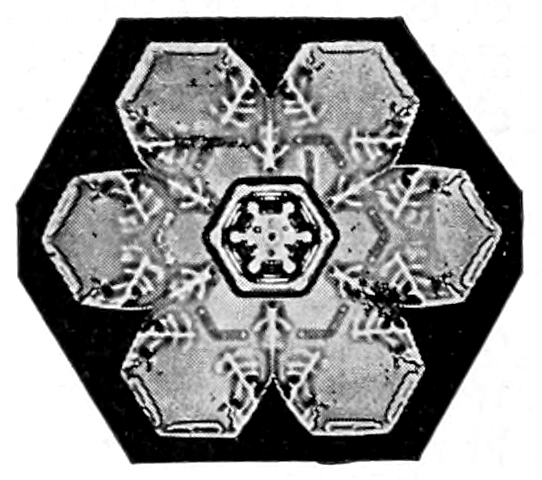
A snow crystal.
Photomicrograph by W. A. Bentley.
For the pupils in the elementary grades it seems best to limit the study of minerals to those which make up our granite and common rocks. In order to teach about these minerals well, the teacher should have at least one set of labelled specimens. Such a collection may be obtained from Edward E. Howell, 612 17th St., N. W., Washington, D. C., and also from Ward’s Natural Science Establishment, College Avenue Rochester, N. Y. These collections vary in number of specimens and price from one to two dollars and are excellent. The teacher should have one or two perfect crystals of quartz, feldspar and calcite. An excellent practice for a boy is to copy these crystals in wood for the use of the teacher.
The physical characteristics used in identifying minerals are briefly as follows:
1. Form. This may be crystalline, which shows the shape of the crystals definitely; granular, like marble, the grains having the internal structure, but not the external form, of crystals; compact, which is without crystalline form, as limestone or flint.
2. Color.
3. Luster or shine, which may be glassy like quartz, pearly like the inside of a shell; silky like asbestos; dull; or metallic like gold.
4. Hardness or resistance to scratching, thus: Easily scratched with the finger nail; cannot be scratched by the finger nail; easily scratched with steel; with difficulty scratched with steel; not to be scratched by steel. A pocket knife is usually the implement used for scratching.
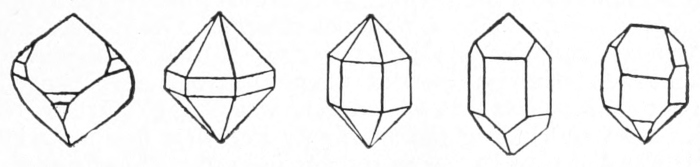
Forms of quartz crystals.
Comstock, Handbook of Nature-Study, Lesson CCXIII. Read the illustrated original at Project Gutenberg. Public domain in the United States.