
Meet the living subject or observe the natural phenomenon first. Ask a few questions aloud and give students time to discover what observation can answer. Leave the unanswered questions for later research. A sketch or written narration belongs in a paper nature journal.
This historical lesson is reproduced as a source, not as current animal-care, collecting, medical, or experiment advice. Observe wildlife without disturbing it, follow local rules, and check present-day safety guidance before any hands-on work. Never look directly at the Sun.
01How to use this lessonA short field guide for the adult
Let the subject lead.
Read the teacher material in advance if possible. During observation, select only the questions the student can investigate today. Do not answer on the student’s behalf while there is still something to see, hear, compare, or measure safely. Afterward, invite an oral narration or a picture in a paper nature journal. Discuss remaining questions only once observation is complete.
02The teacher’s readingComstock’s original preparatory text
The teacher’s reading
Text from the original handbook. Page markers are omitted; layout is adapted for reading. The source may reflect 1911 knowledge and practices.
Teacher’s Story
We most commonly see feldspar as the pinkish portion of granite. This does not mean that feldspar is always pink, for it may be the lime-soda form known as labradorite, which is dark gray, brown or greenish brown, or white; or it may be the soda-lime feldspar called oligoclase, which is grayish green, grayish white, or white; but the most common feldspar of all is the potash feldspar—orthoclase—which may be white, nearly transparent, or pinkish. Orthoclase is different from other feldspars in that, when it splits, its plane surfaces form right angles. Feldspar is next in the scale of hardness to quartz, and will with effort and perseverance scratch glass but will not cut it; it can be scratched with a steel point. Its luster is glassy and often somewhat pearly.
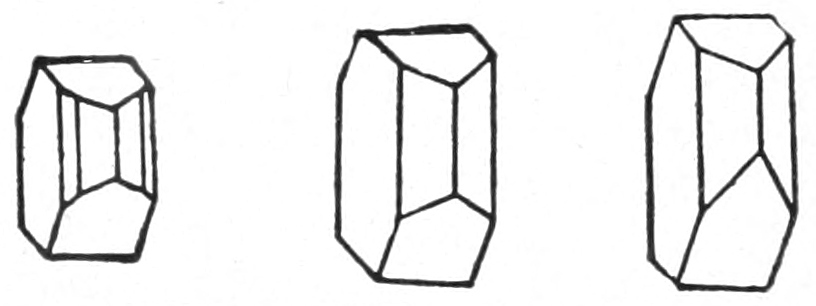
Forms of feldspar crystals.
Maine leads all other states in the production of feldspar. It is quarried and crushed and ground to powder, as fine as flour, to make the clay from which china and all kinds of pottery are made. Our clayey soils are made chiefly from the potash feldspar which is weathered to fine dust. Kaolin, which has been used so extensively in making the finest porcelain, is the purest of all clays, and is formed of weathered feldspar; floor tiling and sewer pipes are also made from ground feldspar. Moonstone is clean, soda-lime feldspar, whitish in color and with a reflection something like an opal.
03The original lesson and questionsTake these to the subject itself
Questions to explore
Choose what fits this encounter. Some original prompts ask for collecting, handling, or other historical activities; use a safe observation instead. Write or draw only in a paper nature journal.
Feldspar
Leading thought—Feldspar is about five times as common as quartz. The crystal is obliquely brick-shaped, and when broken splits in two directions at right angles to each other. It is next in hardness to quartz, and will scratch glass but will not cut it.
Method—If possible, have the common feldspar (orthoclase), the soda-lime feldspar (oligoclase) and the lime-soda feldspar (labradorite).
Observations—1. What is the shape of the feldspar crystal?
2. What colors are your specimens of feldspar? How many kinds have you?
3. What is the luster of feldspar?
4. Can you scratch feldspar with the point of a knife? Can you scratch it with quartz? Can you scratch glass with it?
5. When you scratch feldspar with steel what is the color of the streak left upon it?
6. If feldspar is broken, does it break along certain lines, leaving smooth faces? At what angles do these smooth faces stand to each other?
7. How can you tell feldspar from quartz? Write a comparison of feldspar and quartz, giving clearly the characteristics of both.
8. Hunt over the pebbles found in a sand-bank. Which ones are quartz? Do you find any of feldspar?
9. When there is so much more feldspar than quartz in the earth’s crust, why is there so much more quartz than feldspar in sand?
Comstock, Handbook of Nature-Study, Lesson CCXV. Read the illustrated original at Project Gutenberg. Public domain in the United States.