
Meet the living subject or observe the natural phenomenon first. Ask a few questions aloud and give students time to discover what observation can answer. Leave the unanswered questions for later research. A sketch or written narration belongs in a paper nature journal.
This historical lesson is reproduced as a source, not as current animal-care, collecting, medical, or experiment advice. Observe wildlife without disturbing it, follow local rules, and check present-day safety guidance before any hands-on work. Never look directly at the Sun.
01How to use this lessonA short field guide for the adult
Let the subject lead.
Read the teacher material in advance if possible. During observation, select only the questions the student can investigate today. Do not answer on the student’s behalf while there is still something to see, hear, compare, or measure safely. Afterward, invite an oral narration or a picture in a paper nature journal. Discuss remaining questions only once observation is complete.
02The teacher’s readingComstock’s original preparatory text
The teacher’s reading
Text from the original handbook. Page markers are omitted; layout is adapted for reading. The source may reflect 1911 knowledge and practices.
This lesson has no separate teacher story. Read Comstock’s introduction and method in the original lesson below before meeting the subject.
03The original lesson and questionsTake these to the subject itself
Questions to explore
Choose what fits this encounter. Some original prompts ask for collecting, handling, or other historical activities; use a safe observation instead. Write or draw only in a paper nature journal.
The Barometer
Leading thought—The weight of our atmosphere balances a column of mercury about thirty inches high, and is equal to about fifteen pounds to the square inch. This pressure varies from day to day, and becomes less as the height of the place increases. The barometer is an instrument for measuring the atmospheric pressure. It is used in finding the height of mountains, and, to a certain extent, it indicates changes of the weather.
Compound snow crystals.
Photo by W. A. Bentley.
Method—A glass tube about 36 inches long, closed at one end; a little glass funnel about an inch in diameter at the top; a small cup—a bird’s bathtub is a good size since it allows plenty of room for the fingers; mercury enough to fill the tube and have the mercury an inch or more deep in the cup. Be careful not to spill the mercury in the following process, or you will be as badly off as old Sisyphus with his rolling stone.
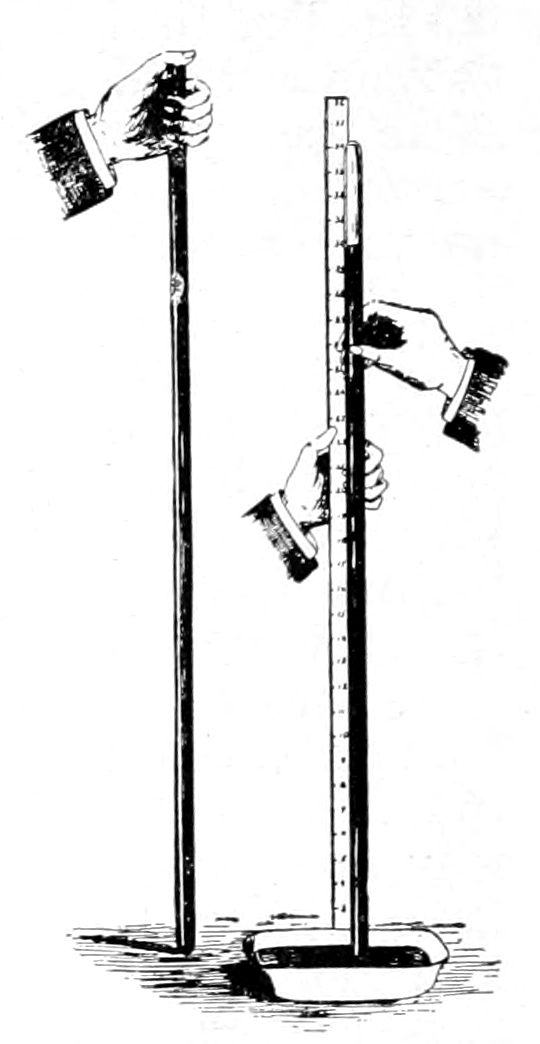
A barometer made by pupils.
Set the closed end of the tube in the cup so that any spilled mercury will not be lost; with the help of the funnel slowly and carefully fill the tube clear to the top with the mercury; empty the rest of the mercury into the cup; place the end of one of the fingers of the left hand tightly over the open end of the tube and keep it there; with the right hand invert the tube, keeping the end closed with the finger, and place the hand, finger and all, beneath the mercury in the cup then remove the finger, keeping the open end of the tube all the time below the surface of the mercury. When the mercury has ceased to fall measure the distance from the surface in the cup to the top of the mercury in the tube.
Observations—1. How high is the column of mercury in the tube?
2. What keeps the mercury in the tube? Place the cup and the tube on a table in the corner of the room, place behind the tube a yardstick, and note whether the column of mercury is the same height day after day. If it varies, why?
3. Would the mercury column be as high in the tube if it were placed on top of a mountain as it would at the foot? Why?
Supplementary reading—Chap. II in The Wonderbook of the Atmosphere, Houston.
Comstock, Handbook of Nature-Study, Lesson CCXXIII. Read the illustrated original at Project Gutenberg. Public domain in the United States.