
Meet the living subject or observe the natural phenomenon first. Ask a few questions aloud and give students time to discover what observation can answer. Leave the unanswered questions for later research. A sketch or written narration belongs in a paper nature journal.
This historical lesson is reproduced as a source, not as current animal-care, collecting, medical, or experiment advice. Observe wildlife without disturbing it, follow local rules, and check present-day safety guidance before any hands-on work. Never look directly at the Sun.
01How to use this lessonA short field guide for the adult
Let the subject lead.
Read the teacher material in advance if possible. During observation, select only the questions the student can investigate today. Do not answer on the student’s behalf while there is still something to see, hear, compare, or measure safely. Afterward, invite an oral narration or a picture in a paper nature journal. Discuss remaining questions only once observation is complete.
02The teacher’s readingComstock’s original preparatory text
The teacher’s reading
Text from the original handbook. Page markers are omitted; layout is adapted for reading. The source may reflect 1911 knowledge and practices.
This lesson has no separate teacher story. Read Comstock’s introduction and method in the original lesson below before meeting the subject.
03The original lesson and questionsTake these to the subject itself
Questions to explore
Choose what fits this encounter. Some original prompts ask for collecting, handling, or other historical activities; use a safe observation instead. Write or draw only in a paper nature journal.
Cassiopeia’s Chair, Cepheus, and the Dragon
Leading thought—To learn to know and to map the constellations which are so near the Pole-star that they never rise or set in our latitude, but seem to swing around the North Star once in twenty-four hours.
Method—Place on the blackboard the diagram given showing the Pole-star, Big and Little Dippers and Cassiopeia’s Chair, and ask for observations and sketches showing their position in the skies the following evening. After the pupils have observed the Chair and know it, add to your diagram, first Cepheus and then the Dragon. After you are sure the pupils know these constellations, give the following lesson. The observations should be made early and late in the same evening and at different times of the month, so that pupils will in every case note the apparent movement of these stars around Polaris.
Observations—1. How many stars form Cassiopeia’s Chair? Make a drawing showing them and their relation to the Pole-star.
2. Is the Queen’s Chair on the same side of the Pole-star as the Big Dipper? Is the top or the bottom of the “W” which forms Cassiopeia’s Chair turned toward the Pole-star?
3. Does Cassiopeia’s Chair move around the Pole-star, like the Big Dipper?
4. How many stars mark the constellation of Cepheus?
5. Make a sketch of these stars and show the two which are pointers toward the North Star.
6. Does Cepheus also move around the Pole-star, and in which direction?
7. Describe where the Dragon lies, and where are his tail and his head in relation to the two Dippers. Make a sketch of the Dragon.
8. Why do all the polar constellations seem to move around the Pole-star every twenty-four hours, and why do they seem to go in a direction opposite the movement of the hands of a clock? What do we mean by “Polar constellations”?
Topics for English Themes—The Story of Queen Cassiopeia, King Cepheus and their daughter, Andromeda; the story of the Dragon.
Supplementary reading—Storyland of the Stars, Pratt.
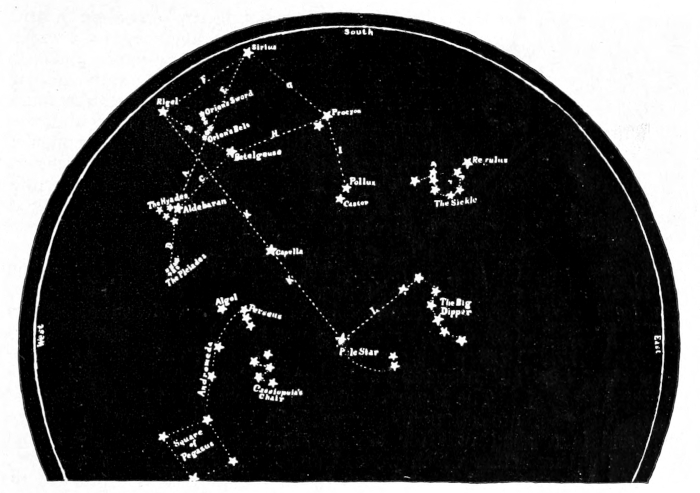
A diagram of the principal stars of winter as seen in early evening late in February.
To use the chart take it in the hands, face the Pole-star and hold the chart above the head so that the side marked east will extend eastward.
Comstock, Handbook of Nature-Study, Lesson CCXXVI. Read the illustrated original at Project Gutenberg. Public domain in the United States.