
Meet the living subject or observe the natural phenomenon first. Ask a few questions aloud and give students time to discover what observation can answer. Leave the unanswered questions for later research. A sketch or written narration belongs in a paper nature journal.
This historical lesson is reproduced as a source, not as current animal-care, collecting, medical, or experiment advice. Observe wildlife without disturbing it, follow local rules, and check present-day safety guidance before any hands-on work. Never look directly at the Sun.
01How to use this lessonA short field guide for the adult
Let the subject lead.
Read the teacher material in advance if possible. During observation, select only the questions the student can investigate today. Do not answer on the student’s behalf while there is still something to see, hear, compare, or measure safely. Afterward, invite an oral narration or a picture in a paper nature journal. Discuss remaining questions only once observation is complete.
02The teacher’s readingComstock’s original preparatory text
The teacher’s reading
Text from the original handbook. Page markers are omitted; layout is adapted for reading. The source may reflect 1911 knowledge and practices.
Teacher’s Story
If a line from Aldebaran pass through the belt of Orion and is extended about as far on the other side, it will reach the Great Dog Star, following at Orion’s heels. This is Sirius, (Sir´-e-us) the most brilliant of all the stars in our skies, glinting with ever changing colors, sometimes blue, at others rosy or white. It must have been of this star that Browning wrote:
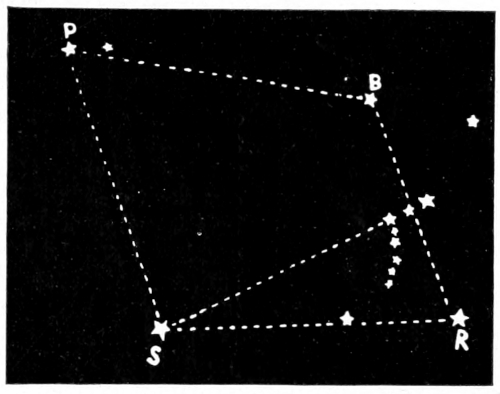
Orion and the Dog Stars.
B, Betelgeuse; R, Rigel; S, Sirius, the Great Dog Star; P, Procyon, the Little Dog Star.
Sirius is a comparatively young star, and is estimated by Proctor to have a diameter of about twelve million miles or fourteen times that of our own sun; it is only eight and one-half light-years away from us and is the most celebrated star in literature. The ancients knew it, the Egyptians worshipped it, Homer sang of it, and it has had its place in the poetry of all ages.
Procyon, (pro´-se-on) the Little Dog Star, was so-called perhaps because it trots up the eastern skies a little ahead of the magnificent Great Dog Star; it gives out eight times as much light as our sun, and is only ten light-years away from us. It has a fainter companion about three or four degrees to the northwest of it.
03The original lesson and questionsTake these to the subject itself
Questions to explore
Choose what fits this encounter. Some original prompts ask for collecting, handling, or other historical activities; use a safe observation instead. Write or draw only in a paper nature journal.
The Two Dog Stars
Leading thought—The Great Dog Star, Sirius, is the most famous of all stars in the literature of the ages. The Two Dog Stars were supposed by the ancients to be following the great hunter, Orion.
Method—Draw upon the board from the chart shown on this page, the constellation of Orion with Sirius and Procyon. Ask the pupils to note that after Orion is well up in the sky a straight line drawn through Orion’s belt and dropping down toward the eastern horizon ends in a beautiful white star, which is Sirius. And that if we draw a line from Betelgeuse to Rigel from Rigel to Sirius and then draw lines to complete a quadrangle, we shall find our lines meet at a bright star just a little too far away to make the figure a square, but making it somewhat kite-shaped instead. This is the Little Dog Star, Procyon, and it has a twin star near it. After giving these directions let the children make the following observations:
1. How do you find Sirius? Which rises first, Orion or Sirius?
2. What color is Sirius? Judging from its color what stage of development do you think it is in?
3. Try and find out how large Sirius is compared with our sun and how near it is to us.
4. Why is Sirius called the Great Dog Star? Is the Little Dog Star nearer to the North Star than Sirius? Which is the brighter, the Great Dog Star or the Little Dog Star? Can you see any fainter star near Procyon?
5. Why is Procyon called the Little Dog Star?
6. Make a chart showing Orion and the two Dog Stars.
Comstock, Handbook of Nature-Study, Lesson CCXXIX. Read the illustrated original at Project Gutenberg. Public domain in the United States.