A turtle painted in fire and sunlight
The first lesson of a naturalist is not naming things. It is learning how to see them.
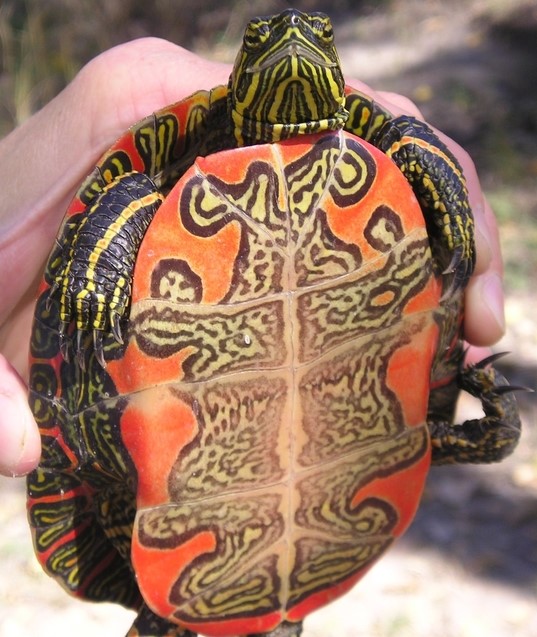
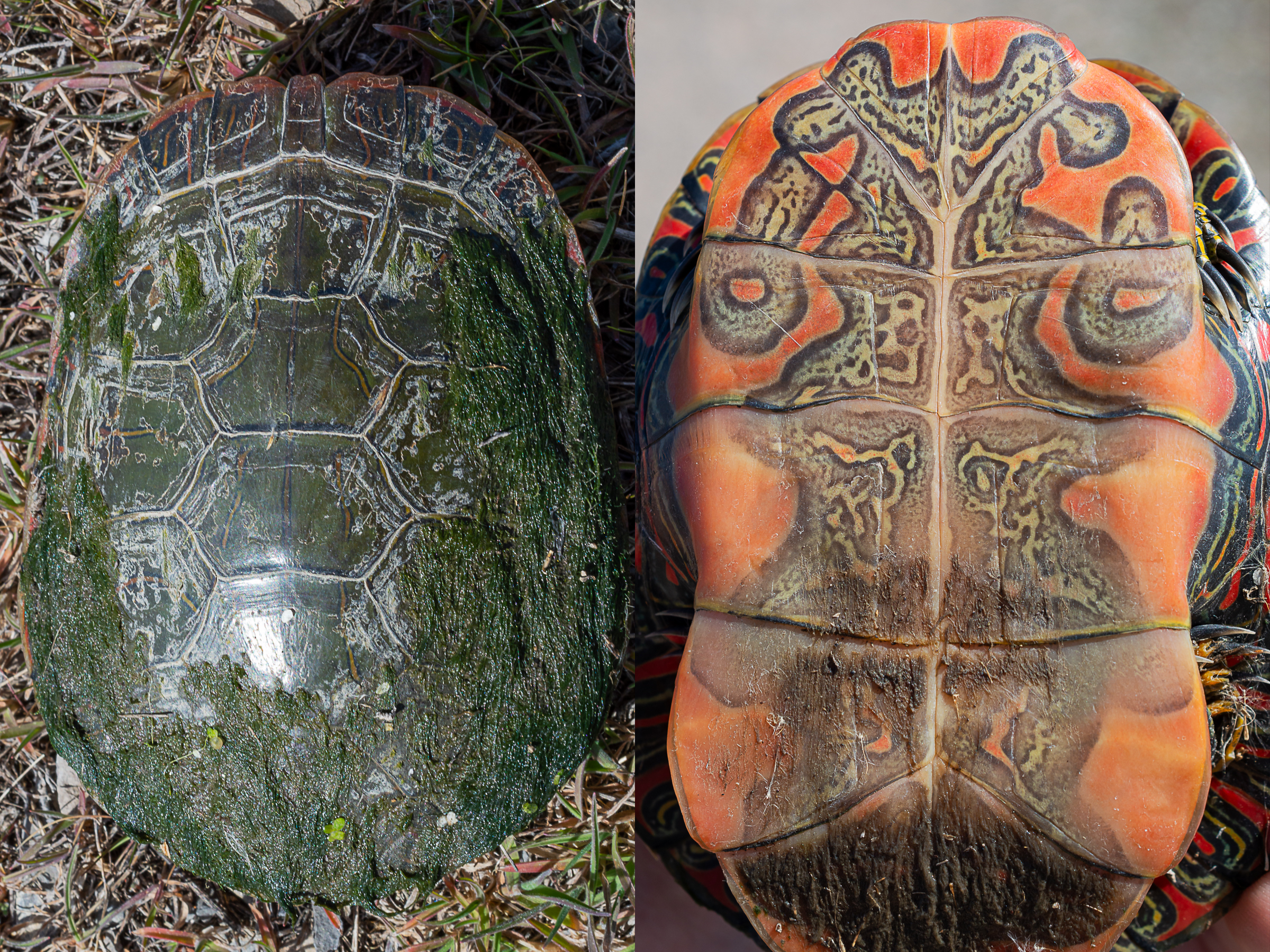
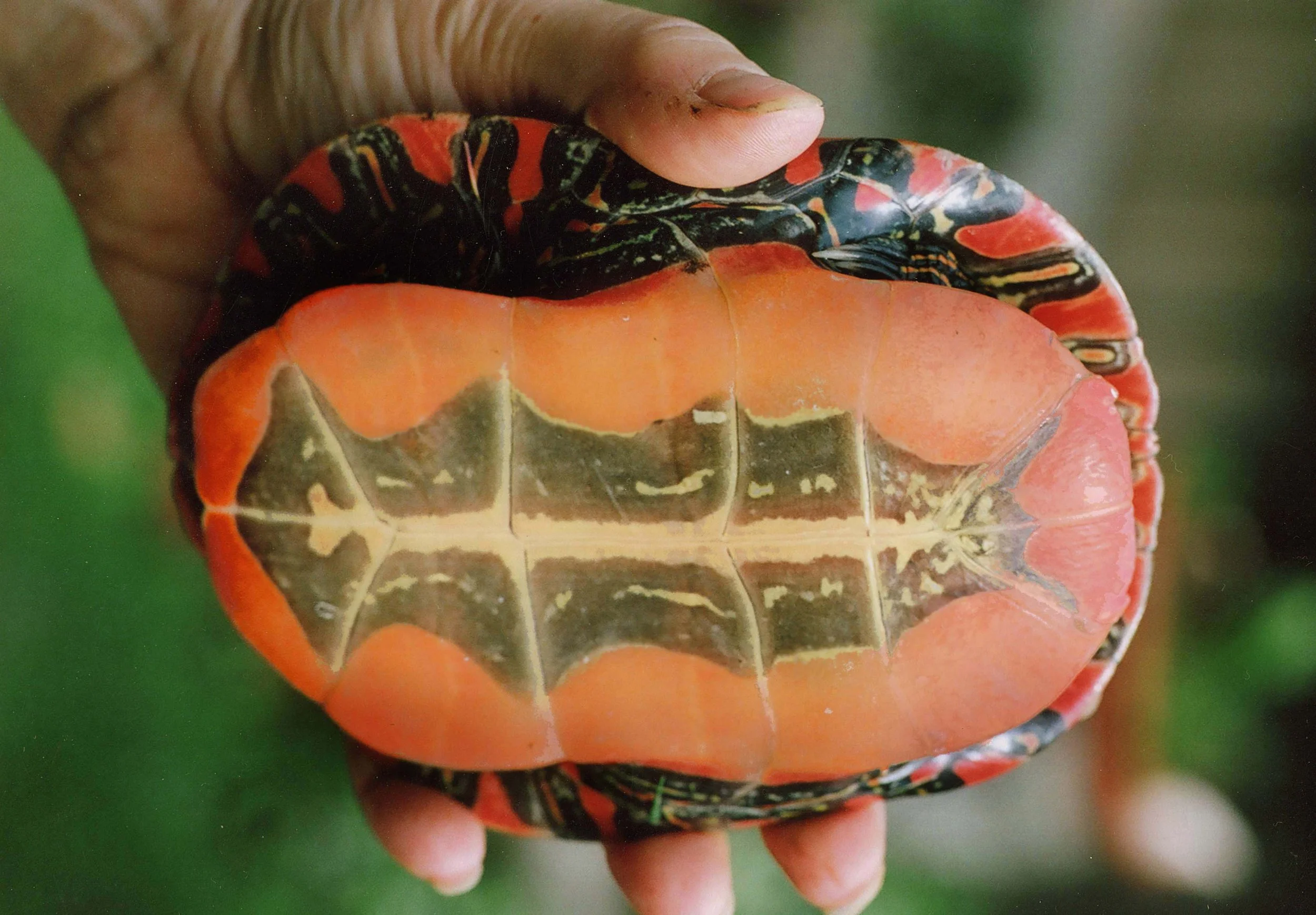
Suppose you saw only the upper shell. It might look like a polished river stone, dark olive or almost black, with fine pale tracings and warm red along the edge. You could easily miss the masterpiece beneath. The lower shell of the western painted turtle can glow orange or red, crossed with branching dark designs as intricate as the lines of a map.
Its scientific name is Chrysemys picta bellii. Chrysemys is associated with “golden turtle,” and picta means “painted.” Bellii honors naturalist Thomas Bell. Scientists usually treat the western form as a subspecies of the painted turtle, Chrysemys picta; some classifications and boundaries of painted-turtle forms remain debated.
How to recognize your turtle
Look for yellow stripes across a dark head and neck; a relatively smooth, low upper shell; warm red-orange marks at the shell margin; and, when visible, an elaborate dark pattern across the underside. Adult females usually become larger than males. Western painted turtles may reach about 25 cm (10 inches) in shell length, although many are smaller.
Do not mistake every red-marked freshwater turtle for a painted turtle. Red-eared sliders often have a conspicuous red patch just behind each eye and a different underside pattern. Many turtles share the same pond; careful identification is a kind of scientific courtesy.
🔍 Naturalist’s test: What would you examine first?
You see a turtle on a log and want to distinguish a western painted turtle from a red-eared slider.
Never turn over or handle a wild turtle merely to examine its plastron. Use a photograph, binoculars, or a field guide. Observing without disturbing is part of knowing.
A house that is not a house
What if your ribs and backbone were built into your coat of armor?
We sometimes say a turtle “carries its home on its back.” It is a lovely image, but biologically, it is not quite right. A turtle's shell isn't a removable house. It is living anatomy: bone, with a surface covering of tough keratin plates called scutes. Its spine and ribs are intimately incorporated into the upper shell. A turtle cannot simply climb out of it, any more than you could step out of your rib cage.
Learning the parts
The carapace is the upper shell, and the plastron is the lower shell. Along the outer rim are marginal scutes. The animal has a horny beak rather than teeth, nostrils above its mouth, eyes adapted for life around water, claws for gripping and digging, and webbed feet for swimming. The opening for the digestive, urinary, and reproductive systems is called the cloaca.
The shell grows with the animal, and is sensitive living tissue. Its scutes can be shed and replaced as the turtle grows. If you find a thin, translucent scute near a pond, you may have discovered a clue to the turtle’s growth, not a broken piece of a detachable house.
Why bask?
Unlike humans, turtles do not maintain a nearly constant warm body temperature through internal heat production. They are ectotherms. Sunlight helps raise their body temperature, improving the conditions for many physiological processes. Basking can also assist with drying the shell. You are not witnessing laziness when a turtle spends an hour in the sunshine. You may be watching a necessary part of its daily work.
Sketch the shell, then ask why.
In your paper nature journal, draw the carapace and plastron as two separate views. Label five structures. Then write a few sentences or narrate aloud: why might an integrated bony shell offer protection while also creating special challenges for movement and breathing?
One pond, a thousand relationships
A turtle is never merely a turtle. It belongs to a living community.
Western painted turtles favor freshwater wetlands: ponds, marshes, quiet backwaters, shallow lakes, and slow streams with soft bottoms and aquatic vegetation. A partially submerged log is a basking platform. Mud is a winter refuge. A stretch of sunny, diggable soil beyond the shoreline is a nursery. Remove one of these places and you have changed the turtle’s world.
Now follow a turtle underwater. It moves past waving pondweed, searches for insect larvae, snaps at a snail, investigates carrion, and takes bites of plant material. It is an omnivore, eating both plants and animals. Younger painted turtles often rely more heavily on animal foods, while mature animals may consume more vegetation; actual diets change with availability and location.
The pond is a food web, not a food chain
Dragonfly nymphs consume smaller creatures. Turtles eat some of those nymphs. Herons and raccoons may eat turtles, particularly the vulnerable young. Plants make energy available to herbivores and omnivores through photosynthesis. Decomposers return nutrients to the system. Nothing in this pond lives independently of everything else.
🧠 Think like an ecologist
A wetland keeps plenty of water but loses its sunny shoreline nesting areas to paving. What is the best prediction?
The extraordinary winter silence
Beneath winter ice, the rules of ordinary breathing are turned upside down.
Imagine the pond in January. The sunlight is weak, the surface is sealed with ice, and the bottom is very cold. A western painted turtle may spend the winter submerged, with no route to the air above. It is not performing a heroic version of holding its breath the way a swimmer would. Its entire physiology has shifted.
Cold slows chemical reactions, and the turtle greatly depresses its metabolism: the energy required to stay alive. It can survive long stretches with very little or even no oxygen. Yet making energy without oxygen creates a problem: lactic acid can accumulate in its tissues. Here the shell becomes more than armor. Minerals in the shell and skeleton help buffer that acid; the shell can also take up some lactate. Researchers have described painted turtles surviving months without oxygen under very cold laboratory conditions.
Notice how carefully we must say this. Painted turtles are not immune to freezing ponds, and their endurance depends on temperature and conditions. An adult trapped where water freezes completely may die. Meanwhile, some hatchlings remain inside their underground nests through the winter, using different freeze-avoidance or freeze-tolerance strategies.
In a landmark review, physiologist Donald C. Jackson described how painted turtles combine extreme energy conservation with shell-assisted acid buffering. Survival of 3–4 months without oxygen at about 3°C was reported under experimental conditions. Read the original scientific article →
Awakening
As temperatures rise, turtles become active, bask and feed.
Growing
Feeding, courtship and nesting take place in warmer months.
Slowing
Cooling water and shortening days change activity patterns.
Enduring
Metabolism slows dramatically beneath cold water or in the nest.
❄️ Physiology puzzle
Why does the shell matter during a long period without oxygen?
The secret of the warm earth
Before a turtle ever sees the pond, the weather has already begun writing its story.
On a warm day, a female leaves the water. Her feet, made for swimming, now become digging tools. She chooses soil that can hold a nest, uses her hind feet to excavate a flask-shaped chamber, deposits a clutch of oval, flexible-shelled eggs, carefully covers them, and returns to the water. There is no guarding mother standing watch. The earth will hold the eggs through their development.
Here is a remarkable secret: for painted turtles, the thermal conditions experienced by the developing embryos help determine whether they become male or female. In many studied populations, cooler incubation conditions generally favor males, warmer conditions females. Real nests fluctuate in temperature, and the story is more complex than a single number: timing, hormones, location, and particular populations matter.
After development, the young hatch with a temporary egg tooth that helps them break the shell. In northern populations, some tiny turtles remain inside the nest until spring, despite having hatched months earlier. They emerge into a world of fish, birds, mammals, insects and many other dangers. Of the numerous eggs produced, relatively few young turtles reach adulthood. Those that do may live for several decades, sometimes beyond fifty years.
Courtship
Male and female encounter one another in water; males may display long foreclaws.
Nesting
Female digs on land, lays eggs, and covers the nest.
Hatching
Embryos develop; young emerge from eggs and sometimes wait until spring.
Maturing
Juveniles grow, avoid predators and eventually reproduce as adults.
The temperature experiment you should never try with real eggs
A scientist can ask whether a warmer nest produces a different ratio of males and females. But wild turtle eggs should never be moved, opened, collected or artificially heated for a school experiment. Instead, study published data or model the concept with imagined nests.
Explore incubation conditions
A simplified illustration of general painted-turtle patterns, not a predictor of sex for any individual wild nest.
28°C
Near a studied population's pivotal temperature, mixtures of males and females may occur.
Temperature thresholds vary; natural daily fluctuations complicate outcomes. Based on published Chrysemys picta research, not a universal rule.🥚 Critical-thinking test
Can you confidently predict the sex of all hatchlings from one reading of a nest thermometer?
What the turtle can teach us
A good scientific answer is not the end of wonder. It creates a better question.
Question one: How do animals survive low oxygen?
Painted turtles are studied by comparative physiologists because their remarkable oxygen deprivation tolerance can reveal how living cells conserve energy and withstand chemical stress. Their abilities cannot simply be transferred to humans, but they illuminate fundamental problems in biology.
Question two: How will warming affect turtle populations?
When offspring sex ratios respond to incubation temperatures, warmer nests can change the balance of males and females. The response is not always simple: daily fluctuations, timing and local adaptation can matter. Scientists study these effects because long-lived turtles replace breeding adults slowly.
Question three: How do we measure a decades-long life?
Some of the strongest turtle research requires years, even decades, of patient observation. Researchers may mark, measure, release and later recapture individuals under approved protocols. Such studies reveal growth, survival, population change and the consequences of losing adult turtles.
Observation: Several turtles bask at one log. Hypothesis: The log offers a warmer, safer basking site than nearby rocks. Prediction: Turtles should use that log more often when its exposure and temperature are favorable. Test: Conduct repeat, non-invasive observations at different times. Never confuse the first observation with proof of the hypothesis.
Design a study without touching a turtle.
Choose one variable you can observe safely: time of day, air temperature, sunlight, water level, or number of basking animals. In your paper nature journal, write a testable question, a prediction, and a plan for repeated observations. What else might influence your result?
Why a common turtle still needs our care
A species may flourish across a continent while a particular population quietly disappears.
The painted turtle is widespread in North America and can be common in suitable habitats. Yet this does not mean every population is secure. In British Columbia, western painted turtles face pressures from wetland loss, roads, disturbed nest sites, invasive red-eared sliders, and predation. Populations near the edge of a species' range may be especially vulnerable.
Turtles face a particular mathematical problem. Many young die naturally, while a population depends heavily on the continued survival of breeding adults. Killing just a few adults each year can be much more damaging than it first appears. Roads between the water and nesting grounds may be especially dangerous for females searching for a place to lay eggs.
Wildlife conservation groups in Canada have protected nests and used carefully managed hatch-and-release and head-start programs. These are expert-directed interventions, not activities for ordinary observers to attempt themselves.
Do
Observe from a distance, protect wetlands and shorelines, keep pets away from nesting areas, never release pet turtles, and support reputable conservation organizations.
Do not
Take wild turtles or eggs home, move nests, use turtles as classroom specimens without professional guidance, or disturb basking and nesting animals.
When a turtle is crossing a road, prioritize your own safety. Follow the guidance of local wildlife authorities; never put yourself or other motorists at risk. Different regions may have specific protections and handling rules.
Become a student of the pond
The most astonishing discoveries begin with attention.
Bring a paper nature journal and a pencil. Let the pond have your attention before you try to name everything in it.
Expedition I · Sit still
Spend 20 quiet minutes at a wetland. In your nature journal, record what you see and hear before trying to identify species. Sketch one relationship between an animal and its habitat.
Expedition II · One log, three visits
Return to the same observation point at three different times. Are basking turtles more or less visible? In your nature journal, record the weather, date and time; keep what you saw separate from what you think it means.
Expedition III · Build a food web
Identify at least eight pond organisms, including a producer, consumers, decomposers, predator and prey. In your nature journal, draw arrows showing the direction of energy transfer.
Expedition IV · Research debate
Investigate: “If turtles survive winter ice, why does habitat protection still matter?” In your nature journal, outline an answer using at least three high-quality sources, then discuss it aloud with someone else.
What are you wondering about now?
Turn to a fresh page in your paper nature journal. Sketch one detail you noticed, describe it in your own words, and write a question to carry on your next visit. Tell someone the story of your observation before looking up an answer.
A naturalist's review
Use these as prompts for oral narration or a page in your nature journal. Which ideas could you explain to another observer?
- Identify the carapace, plastron and scutes.
- Explain why basking matters.
- Describe how a painted turtle endures low oxygen in winter.
- Trace its life cycle.
- Explain how nest temperature can influence offspring sex.
- Sketch a pond food web and identify human threats.
- Pose a question and design a respectful field investigation.
Words that open doors
Learning the right name makes it possible to ask a more exact question.
Open the scientist's library
Follow the trail from a good story to the evidence behind it.
Excellent identification information, habitat, range, photographs, and a short painted turtle video in its media gallery.
Extensive expert field account, natural history, food ecology, reproduction, regional distribution and research references.
Clear descriptions of anatomy, sex differences, diet and ecological relationships.
Professional-level information on habitats, threats, conservation and western populations.
Detailed account of nesting, incubation, maturity, winter survival and lifespan.
Conservation stories, turtle photographs and professionally managed hatchling-recovery efforts.
Peer-reviewed physiological research explaining metabolic depression and shell buffering of acid.
Advanced research on how altered incubation temperature profiles can affect sex ratios and survival.
Deep-dive study on turtle reproduction, sex ratios and what observations can and cannot establish.
Species naming, photographs, and occurrence information useful for discussing native and introduced populations.
🎬 Film room · Watch with a naturalist’s eyes
Start with the short western painted turtle video in the Missouri Conservation media gallery. Then explore the wildlife conservation project to see how humans help vulnerable populations. For longer documentary selections, browse western painted turtle field videos, confirming producer and species before treating claims as reliable.
Viewing challenge: In every video, distinguish a direct observation, a narrator's interpretation, and a scientific claim requiring evidence.
This is an original educational synthesis, not a peer-reviewed paper. Regional variation is significant, especially for lifespan, maturity and egg development. Photographs load from outside sites and remain credited to their sources; obtain permission or suitable licenses before permanent public publishing or hosting copies. All scientific resource links are provided for direct verification.
The next time you pass a pond, you may not see a painted turtle. But perhaps you will notice a sun-warmed log, a patch of soft earth, a dragonfly traveling just above the water, or the last ice of winter loosening at the bank. You will know that these ordinary things belong to a far larger story. And perhaps, when a little dark head rises between the lily leaves, you will understand that the world has been full of wonders all along. We simply needed to learn how to look.