
Meet the living subject or observe the natural phenomenon first. Ask a few questions aloud and give students time to discover what observation can answer. Leave the unanswered questions for later research. A sketch or written narration belongs in a paper nature journal.
This historical lesson is reproduced as a source, not as current animal-care, collecting, medical, or experiment advice. Observe wildlife without disturbing it, follow local rules, and check present-day safety guidance before any hands-on work. Never look directly at the Sun.
01How to use this lessonA short field guide for the adult
Let the subject lead.
Read the teacher material in advance if possible. During observation, select only the questions the student can investigate today. Do not answer on the student’s behalf while there is still something to see, hear, compare, or measure safely. Afterward, invite an oral narration or a picture in a paper nature journal. Discuss remaining questions only once observation is complete.
02The teacher’s readingComstock’s original preparatory text
The teacher’s reading
Text from the original handbook. Page markers are omitted; layout is adapted for reading. The source may reflect 1911 knowledge and practices.
This lesson has no separate teacher story. Read Comstock’s introduction and method in the original lesson below before meeting the subject.
03The original lesson and questionsTake these to the subject itself
Questions to explore
Choose what fits this encounter. Some original prompts ask for collecting, handling, or other historical activities; use a safe observation instead. Write or draw only in a paper nature journal.
Hedgehog Fungi
There is something mysterious about all fungi, but perhaps none of these wonderful organisms so strangely impresses the observer as the fountainlike masses of creamy white or the branching white coral that we see growing on a dead tree trunk. The writer remembers as a child that the finding of these woodland treasures made her feel as if she were in the presence of the supernatural, as if she had discovered a fairy grotto or a kobold cave. The prosaic name of hedgehog fungi has been applied to these exquisite growths. Their life story is simple enough. The spores falling upon dead wood start threads which ramify within it and feed on its substance, until strong enough to send out a fruiting organ. This consists of a stem, dividing into ascending branches; from these branches, depending like the stalactites in a cave, are masses of drooping spines, the surface of each bearing the spores. And it is so natural for these spines to hang earthward that they are invariably so placed when the tree is in the position in which they grew. There is one species called the “satyr’s beard,” sometimes found on living trees, which is a mere bunch of downward-hanging spines; the corallike species is called Hydnum coraloides, and the one that looks like an exquisite white frozen fountain, and may be seen in late summer or early autumn growing from dead limbs or branches, is the bear’s head fungus; it is often eight inches across.
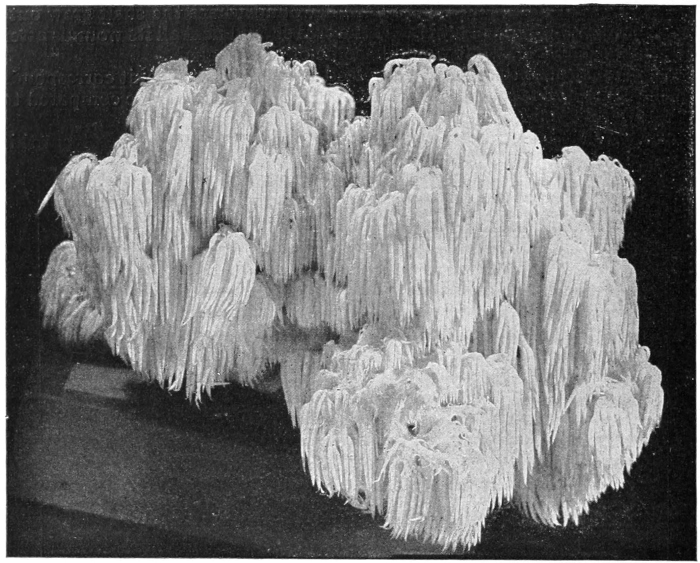
The bear’s head fungus.
Photo by George F. Atkinson.
Observations—1. These fungi come from a stem which extends into the wood.
2. This stem divides into many branchlets.
3. From these branchlets there hang long fleshy fringes like miniature icicles.
4. These fringes always hang downward when the fungus is in natural position.
5. These fringes bear the spores.
Comstock, Handbook of Nature-Study, Lesson CLXXXII. Read the illustrated original at Project Gutenberg. Public domain in the United States.