
Meet the living subject or observe the natural phenomenon first. Ask a few questions aloud and give students time to discover what observation can answer. Leave the unanswered questions for later research. A sketch or written narration belongs in a paper nature journal.
This historical lesson is reproduced as a source, not as current animal-care, collecting, medical, or experiment advice. Observe wildlife without disturbing it, follow local rules, and check present-day safety guidance before any hands-on work. Never look directly at the Sun.
01How to use this lessonA short field guide for the adult
Let the subject lead.
Read the teacher material in advance if possible. During observation, select only the questions the student can investigate today. Do not answer on the student’s behalf while there is still something to see, hear, compare, or measure safely. Afterward, invite an oral narration or a picture in a paper nature journal. Discuss remaining questions only once observation is complete.
02The teacher’s readingComstock’s original preparatory text
The teacher’s reading
Text from the original handbook. Page markers are omitted; layout is adapted for reading. The source may reflect 1911 knowledge and practices.
This lesson has no separate teacher story. Read Comstock’s introduction and method in the original lesson below before meeting the subject.
03The original lesson and questionsTake these to the subject itself
Questions to explore
Choose what fits this encounter. Some original prompts ask for collecting, handling, or other historical activities; use a safe observation instead. Write or draw only in a paper nature journal.
The Scarlet Saucer (Sarcocypha coccinea)
The heart of the child, searching the woods for hepaticas—woods where snow banks still hold their ground on north slopes—is filled with delight at finding these exquisite saucerlike fungi. They are more often found on fallen rotting branches which are more or less buried in leaves, and there are likely to be several of different sizes on the same stick. When they grow unhindered and while they are young, they are very perfectly saucer-shaped and range from the size of a pea to an inch or two across. But the larger they are the more likely are they to be distorted, either by environment or by the bulging of rapid growth. The under side of the saucer is beautifully fleshlike in color and feeling and is attached at the middle to the stick. The inside of the saucer is the most exquisite scarlet shading to crimson. This crimson lining bears the spores in little sacs all over its surface.
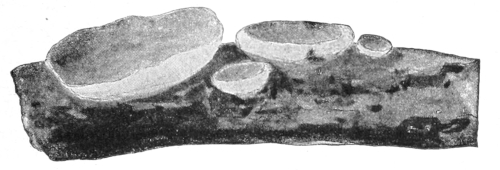
Scarlet saucer.
Observations—1. Where did you find the fungus?
2. What is the shape of the saucer? How large is it? Is it regular and beautiful or irregular and distorted?
3. What is the color inside?
4. What is the color outside?
5. Turn the one you bring in bottom side up—that is, scarlet side down—on a piece of white paper, and see whether you can get a spore harvest.
Comstock, Handbook of Nature-Study, Lesson CLXXXIII. Read the illustrated original at Project Gutenberg. Public domain in the United States.